
When a car accident occurs in Peoria, AZ, the path to recovery can feel overwhelming, especially when the other driver does not have insurance or leaves the scene without providing coverage information. Uninsured and underinsured motorist accidents often create confusion about how medical bills, lost wages, and property damage will be handled. At Harris Injury Law, our legal team supports accident victims across Peoria and Maricopa County by helping them understand their rights and navigate the claims process under Arizona law.
Harris Injury Law is located at 1136 E Campbell Ave, Phoenix, AZ 85014, and proudly works with residents throughout Peoria, AZ who need legal representation after uninsured motorist collisions. Call (480) 648-0319 to schedule a no-obligation case evaluation with a member of our team.
Car accidents happen at intersections, on residential streets, and along major freeway corridors running through Peoria. When the at fault driver lacks proper insurance, accident victims often face immediate financial challenges and uncertainty about medical expenses, repairs, and what steps to take next. Our Peoria personal injury lawyers help clarify the law, handle communication with insurance companies, and provide direction during the claims process.
At Harris Injury Law, clients work directly with an attorney from the beginning of their case. Many accident victims feel overwhelmed when insurance companies request statements, documentation, or recorded interviews. Having a local attorney involved early may help reduce common issues and support an understanding of your rights.
Our legal team has experience with personal injury cases involving uninsured motorists, underinsured motorists, hit-and-run incidents, and car accidents where the insurance company denies valid claims. These cases often involve complex insurance details, policy limits, and questions of comparative negligence.
Car accident injuries such as broken bones, spinal cord injuries, and traumatic brain injuries can require long-term medical care. When severe injuries occur, the uncertainty of dealing with an uninsured at fault driver can add significant stress. We provide guidance on medical treatment coordination and explain available uninsured motorist coverage and legal options.
Accidents happen on roads like Lake Pleasant Parkway, Thunderbird Road, and near Park West. Our familiarity with local intersections, police procedures, and how the Peoria Police Department documents collisions allows us to gather critical evidence more efficiently when building a personal injury claim.
Insurance companies may minimize injury claims, dispute liability, or suggest that accident victims have made too many attempts to provide documentation. Our experienced attorneys understand how to navigate these challenges, negotiate with insurers regarding claims and address disputed or improper practices when they arise.
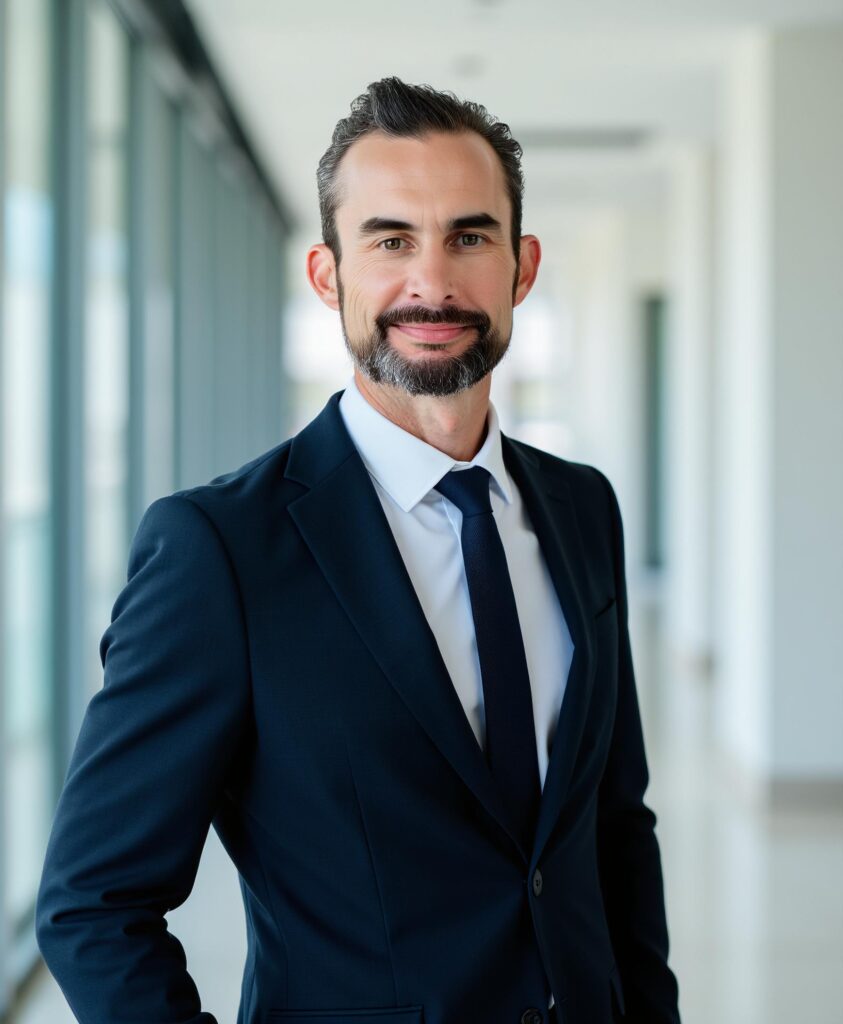
Attorney Jason A. Harris is one of the few personal injury attorneys in Arizona who regularly handles both personal injury and workers’ compensation matters. This dual background allows him to assist accident victims whose injuries involve overlapping legal issues.
Since 2006, Jason has represented individuals injured in car accidents, trucking incidents, drunk driving crashes, pedestrian accidents, and wrongful death cases. His experience includes personal injury lawsuit filings, settlement negotiations, and providing representation in Maricopa County Superior Court.
Many uninsured motorist accidents involve multiple vehicles, unclear liability, or a negligent driver who flees the scene. Jason’s familiarity with complex personal injury law issues enables him to evaluate whether additional coverage options may be available in a Peoria car accident claim.
Clients appreciate Jason’s clear communication and efforts to keep them informed throughout their case.
Jason spends significant time working with clients across the Greater Phoenix area. His understanding of Peoria neighborhoods, such as Vistancia, Fletcher Heights, Westwing Mountain, and areas surrounding Rio Vista Community Park, helps him relate to local concerns and better understand where accidents occur.
Some Peoria drivers do not maintain the minimum insurance coverage required under Arizona law. When accidents happen, victims often must rely on their own uninsured motorist coverage.
Hit-and-run accidents remain a significant concern across Arizona. Data from the Arizona Department of Transportation (ADOT) shows thousands of hit-and-run incidents statewide each year, underscoring the need for uninsured motorist protection.
Alcohol-related collisions may involve drivers who do not carry insurance or whose policy lapsed. A drunk driver may also flee the scene, leaving victims with limited information about coverage.
Distracted driving continues to contribute to Peoria car accidents. Texting, phone use, and other distractions can cause drivers to lose control, drift into lanes, or collide with stopped vehicles.
Drivers who operate vehicles unlawfully often avoid purchasing insurance. If an accident in Peoria involves such a driver, victims may need uninsured motorist coverage to seek compensation where available.
Roads like Loop 101, Bell Road, and Grand Avenue see heavy traffic volumes. Accidents on these high-speed corridors often involve significant property damage and severe injuries.
According to the Insurance Research Council (IRC), Arizona has one of the higher rates of uninsured motorists nationally. This places drivers in Peoria at increased risk when collisions occur.
The Arizona Department of Transportation (ADOT) publishes annual crash reports indicating how often Peoria car accidents involve injury, property damage, or fatal crashes. These reports help illustrate why uninsured motorist coverage remains essential.
Maricopa County consistently reports high numbers of hit-and-run collisions. Many of these incidents involve drivers who lack insurance or who leave to avoid consequences, as supported by the statewide findings presented in ADOT’s crash reports.
Data from the National Highway Traffic Safety Administration (NHTSA) highlights that fatal crashes involving uninsured drivers occur nationwide each year. Peoria residents benefit from understanding these risks when evaluating coverage.
The U.S. Census Bureau reports that Peoria continues to experience population growth. With more vehicles on the road, the likelihood of interacting with an uninsured or underinsured driver increases.
Arizona law allows accident victims to pursue compensation through their own uninsured motorist policy when the other driver is uninsured or unidentified.
A personal injury claim using uninsured motorist benefits can help cover medical expenses, lost income, and other expenses related to your injuries.
If the insurance company argues that the accident victim was partially responsible, comparative negligence may impact the value of a Peoria car accident claim. Our legal team helps address these arguments.
Families who lose loved ones may pursue wrongful death claims, including support for funeral and burial expenses. Uninsured motorist coverage may offer compensation in these tragic circumstances.
When your vehicle is damaged, uninsured motorist property damage benefits may apply. Our attorneys review policies to determine eligibility.
If an insurance company denies benefits, delays payment, or disputes the value of your injuries, an attorney can help challenge the decision and explain available legal options under Arizona law.
Our legal team gathers critical evidence such as witness statements, photos, surveillance footage, and the police report from the Peoria Police Department.
We review all applicable insurance policies to determine how uninsured motorist benefits may apply in your case.
Accident victims should not have to manage insurance company tactics or pressure from an insurance adjuster. We handle communications, negotiations, and documentation on your behalf.
In cases involving severe injuries or catastrophic injuries, including spinal cord injuries or traumatic brain injuries, our team provides guidance on medical care and treatment coordination.
Financial compensation, where available, may relate to medical bills, lost wages, future medical treatment, and other documented expenses. Our attorneys work to build a detailed assessment of how the accident impacts your life.
If the insurance company fails to offer a fair settlement, we are prepared to file a personal injury lawsuit in Maricopa County Superior Court and continue evaluating appropriate legal options.
We provide legal representation to families who lose loved ones because of someone else’s negligence, including uninsured or underinsured drivers.
Collisions occur at all hours, often when people least expect them. Whether the accident involves distracted driving, drunk driving, or multiple vehicles, our attorneys aim to respond promptly and are available to discuss your case as scheduling allows.
Harris Injury Law offers phone consultations, email updates, and easy access through our online contact form. Clients can reach out after hours, and we aim to respond promptly.
Uninsured motorist cases often involve legal claim disputes, questions about fault, and situations where the other driver cannot be located. We help clients navigate every complication.
If you’re dealing with medical expenses, lost income, property damage, or uncertainty after an accident with an uninsured driver, you may benefit from speaking with a Peoria car accident attorney at Harris Injury Law.
Call (480) 800-4878 today to schedule your free consultation. You can speak with an attorney who can explain your rights and discuss your options under Arizona law.
Our legal team can help you understand your options and explain potential avenues for compensation under Arizona law.
Call (480) 800-4878 or reach us through our online contact form to get started.
to assist you with your uninsured motorist accident case.
Call or text now for a free consultation.
⭐⭐⭐⭐⭐
“They helped me understand my insurance coverage.”
“After my accident in Peoria, the other driver had no insurance. I didn’t know how medical bills would be paid. Harris Injury Law explained everything and guided me through the claims process. Having direct access to an attorney made a huge difference.”
- D.M., Peoria
⭐⭐⭐⭐⭐
“Professional, responsive, and thorough.”
“My insurance company denied my injury claim even though the accident wasn’t my fault. Harris Injury Law reviewed my uninsured motorist policy, challenged the denial, and helped me understand options for compensation permitted under Arizona law.”
- A.R., Peoria
⭐⭐⭐⭐⭐
“Highly recommended for uninsured motorist issues.”
“When a negligent driver sideswiped my vehicle near Park West and fled, I felt lost. The legal team gathered evidence, contacted witnesses, and helped me move forward confidently.”
- J.L., Peoria
Client testimonials do not guarantee similar outcomes. Results depend on the facts of each case.

Located at 1136 E Campbell Ave, Phoenix, AZ 85014. Harris Injury Law, PLLC specializes in auto and truck accidents and workers’ compensation. Speak directly with your lawyer from the beginning. Same-day and emergency consultations are available. You never pay out of pocket. Call us at any time – 24/7.
Harris Injury Law
We firmly believe that the internet should be available and accessible to anyone, and are committed to providing a website that is accessible to the widest possible audience, regardless of circumstance and ability.
To fulfill this, we aim to adhere as strictly as possible to the World Wide Web Consortium’s (W3C) Web Content Accessibility Guidelines 2.1 (WCAG 2.1) at the AA level. These guidelines explain how to make web content accessible to people with a wide array of disabilities. Complying with those guidelines helps us ensure that the website is accessible to all people: blind people, people with motor impairments, visual impairment, cognitive disabilities, and more.
This website utilizes various technologies that are meant to make it as accessible as possible at all times. We utilize an accessibility interface that allows persons with specific disabilities to adjust the website’s UI (user interface) and design it to their personal needs.
Additionally, the website utilizes an AI-based application that runs in the background and optimizes its accessibility level constantly. This application remediates the website’s HTML, adapts Its functionality and behavior for screen-readers used by the blind users, and for keyboard functions used by individuals with motor impairments.
If you’ve found a malfunction or have ideas for improvement, we’ll be happy to hear from you. You can reach out to the website’s operators by using the following email
Our website implements the ARIA attributes (Accessible Rich Internet Applications) technique, alongside various different behavioral changes, to ensure blind users visiting with screen-readers are able to read, comprehend, and enjoy the website’s functions. As soon as a user with a screen-reader enters your site, they immediately receive a prompt to enter the Screen-Reader Profile so they can browse and operate your site effectively. Here’s how our website covers some of the most important screen-reader requirements, alongside console screenshots of code examples:
Screen-reader optimization: we run a background process that learns the website’s components from top to bottom, to ensure ongoing compliance even when updating the website. In this process, we provide screen-readers with meaningful data using the ARIA set of attributes. For example, we provide accurate form labels; descriptions for actionable icons (social media icons, search icons, cart icons, etc.); validation guidance for form inputs; element roles such as buttons, menus, modal dialogues (popups), and others. Additionally, the background process scans all the website’s images and provides an accurate and meaningful image-object-recognition-based description as an ALT (alternate text) tag for images that are not described. It will also extract texts that are embedded within the image, using an OCR (optical character recognition) technology. To turn on screen-reader adjustments at any time, users need only to press the Alt+1 keyboard combination. Screen-reader users also get automatic announcements to turn the Screen-reader mode on as soon as they enter the website.
These adjustments are compatible with all popular screen readers, including JAWS and NVDA.
Keyboard navigation optimization: The background process also adjusts the website’s HTML, and adds various behaviors using JavaScript code to make the website operable by the keyboard. This includes the ability to navigate the website using the Tab and Shift+Tab keys, operate dropdowns with the arrow keys, close them with Esc, trigger buttons and links using the Enter key, navigate between radio and checkbox elements using the arrow keys, and fill them in with the Spacebar or Enter key.Additionally, keyboard users will find quick-navigation and content-skip menus, available at any time by clicking Alt+1, or as the first elements of the site while navigating with the keyboard. The background process also handles triggered popups by moving the keyboard focus towards them as soon as they appear, and not allow the focus drift outside it.
Users can also use shortcuts such as “M” (menus), “H” (headings), “F” (forms), “B” (buttons), and “G” (graphics) to jump to specific elements.
We aim to support the widest array of browsers and assistive technologies as possible, so our users can choose the best fitting tools for them, with as few limitations as possible. Therefore, we have worked very hard to be able to support all major systems that comprise over 95% of the user market share including Google Chrome, Mozilla Firefox, Apple Safari, Opera and Microsoft Edge, JAWS and NVDA (screen readers).
Despite our very best efforts to allow anybody to adjust the website to their needs. There may still be pages or sections that are not fully accessible, are in the process of becoming accessible, or are lacking an adequate technological solution to make them accessible. Still, we are continually improving our accessibility, adding, updating and improving its options and features, and developing and adopting new technologies. All this is meant to reach the optimal level of accessibility, following technological advancements. For any assistance, please reach out to