
 Skip to content
 An unexpected injury can leave you with medical bills, lost income, and difficult decisions. If someone else caused your injury, you may have a personal injury claim under Arizona law.
Harris Injury Law helps injured people in Phoenix and throughout Arizona understand their legal options. Attorney Jason A. Harris has practiced personal injury law since 2006.
We handle claims involving car accidents, truck crashes, motorcycle accidents, pedestrian injuries, premises liability, workplace injuries, wrongful death, and other serious injuries.
Your case starts with understanding what happened, who may be responsible, and what evidence supports your claim.
Choosing a personal injury lawyer is an important decision. You should know who will handle your case and how the firm will communicate with you.
Harris Injury Law emphasizes direct communication with attorney Jason Harris.
You are not left to figure out the legal process alone. You can discuss your case with the attorney and legal team handling it.
Jason Harris handles both personal injury and workers’ compensation matters. That experience can matter when a workplace accident also involves a third party.
The legal issues can differ between a workers compensation claim and a third party injury claim.
Jason Harris has practiced law since 2006. His reported case experience includes car accidents, truck accidents, motorcycle accidents, construction injuries, defective products, and wrongful death claims.
Contingency Fee Representation
The firm handles qualifying personal injury matters on a contingency fee basis. Your written agreement should include the specific fee and case expenses before representation begins.

Jason A. Harris has practiced law since 2006. His practice includes personal injury and workers’ compensation matters in Arizona.
His reported experience includes:
Jason earned his undergraduate degree from the University of Mississippi. He later earned his law degree from Western Michigan University’s Thomas M. Cooley Law School.
Harris Injury Law emphasizes direct attorney access throughout the legal process.For an injury claim, that means you can discuss the facts of your case with the attorney and legal team working on it.
There is no fixed settlement amount for every personal injury case. The value of a claim depends on the facts and available evidence.
Important factors can include:
Insurance coverage can also affect the amount available to resolve a claim. Arizona law allows a claimant’s damages to be reduced based on the claimant’s percentage of fault.
Arizona Revised Statutes Section 12-2505 sets out the state’s comparative negligence rule. The value of your claim cannot be determined from the accident type alone.
The medical evidence, liability evidence, financial losses, insurance coverage, and other case facts all matter. A case review can help identify the issues that may affect your claim.
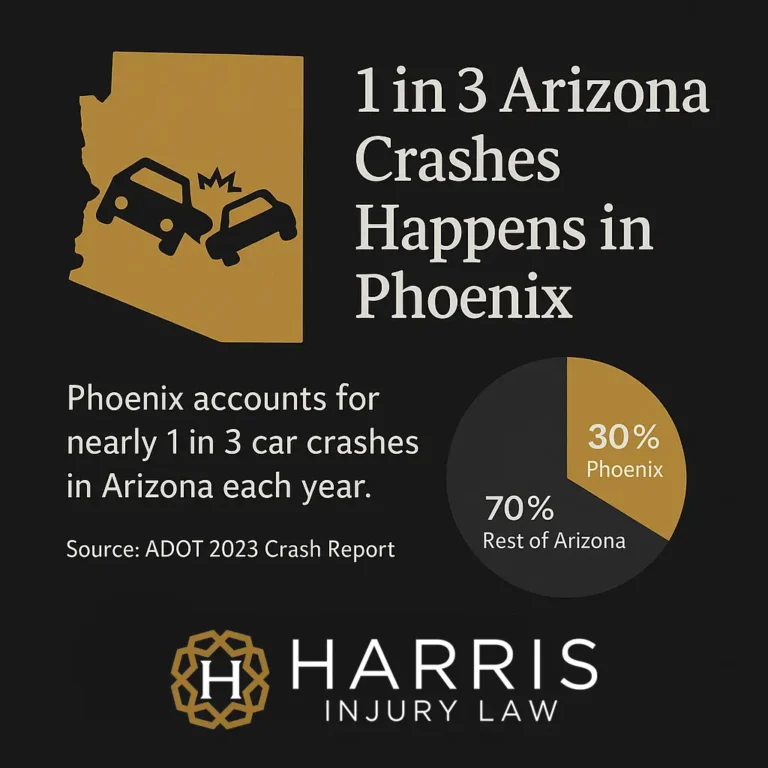
To understand the urgent need for experienced personal injury lawyers in Phoenix, consider the following statistics:
Arizona reported 122,247 motor vehicle accidents in 2023, with 51,549 injuries and 1,307 fatalities, according to the Arizona Department of Transportation (ADOT).
Phoenix alone accounted for nearly 30% of the state’s car crashes. (Make Roads Safe)
Slip and fall injuries remain one of the leading causes of ER visits in Arizona, particularly among the elderly. (Arizona Falls Prevention Coalition)
According to the Centers for Disease Control and Prevention (CDC), traumatic brain injuries and spinal cord injuries are most frequently caused by vehicle crashes and workplace accidents, both common in Phoenix’s fast-paced environment.
These statistics emphasize why having an experienced personal injury attorney is crucial when dealing with medical bills, lost wages, emotional trauma, and permanent injuries.
Personal injury cases can involve different accidents, injuries, and legal issues.
Harris Injury Law handles a range of injury claims in Phoenix and throughout Arizona.
A car crash can cause medical expenses, missed work, property damage, and long term injuries. You can approach a Phoenix car accident lawyer.
Commercial truck crashes can involve drivers, trucking companies, insurers, vehicle owners, and other parties. A Phoenix Truck Accident Lawyer is every time ready to serve you
Motorcycle crashes can cause serious injuries because riders have less physical protection than people inside passenger vehicles.
Uber and Lyft crashes can involve different insurance issues depending on the driver’s status and circumstances.
A fatal accident can create legal claims for eligible surviving family members. Harris Injury Law Firm can be your Phoenix Wrongful Death Lawyer.
Some accidents cause traumatic brain injuries, spinal cord injuries, fractures, burns, or other serious harm. These cases may involve long term medical care and substantial financial losses.
The first priority after an accident is your health. Once you are safe, take steps that can protect your health and preserve important evidence.
Seek medical care when you need it. Some injuries may not become obvious immediately. Follow your medical provider’s treatment instructions. Keep your medical records, bills, prescriptions, and treatment information.
Report the accident to the appropriate authority when required. For qualifying motor vehicle crashes, Arizona law imposes duties on drivers who are involved in an accident.
Take photographs when it is safe. Photograph vehicle damage, road conditions, visible injuries, property damage, signs, and other relevant details.
Get names and contact information for witnesses when possible. Witness statements can become important when people later disagree about what happened.
Save medical bills and records. Keep documents showing missed work or other financial losses.
An insurance adjuster may contact you soon after an accident. Do not assume that every request or settlement offer protects your interests.
Consider obtaining legal advice before accepting a settlement or giving a detailed recorded statement to another party’s insurer.
Early legal guidance can help identify deadlines, insurance issues, evidence problems, and potential claims.
You do not need to wait until your medical treatment ends before asking about your legal options.
A personal injury claim needs evidence. The evidence must connect the accident, liability, injuries, and financial losses.
We start by understanding the accident and the people involved. The type of accident determines which evidence may matter.
Depending on the case, evidence may include:
We look at the facts that may show who caused or contributed to the accident. Different cases involve different legal issues.
Medical records help establish the nature and extent of an injury. They can also help document treatment and financial losses.
Insurance coverage can affect a personal injury claim. Our legal team can communicate with insurers and address claim issues during the process.
Some cases resolve through negotiation. Others require a lawsuit.
The appropriate strategy depends on the evidence, liability issues, damages, insurance coverage, and other facts.
The goal is to build the case around evidence rather than assumptions.
Arizona personal injury claims can involve strict deadlines and specific rules. The applicable rule depends on the type of claim.
Arizona Revised Statutes Section 12-542 generally requires an action for personal injury to be commenced within two years after the cause of action accrues.
Arizona law reduces damages based on the claimant’s relative degree of fault when comparative negligence applies.
A.R.S. Section 12-2505 states that the claimant’s action is not barred simply because the claimant was partly at fault. The damages are reduced according to the claimant’s relative fault.
A personal injury case can involve more than one responsible party.
A.R.S. Section 12-2506 contains rules for allocating fault among defendants and other persons who contributed to an injury.
Claims against public entities and public employees have additional rules. Arizona generally requires an action against a public entity or public employee to be brought within one year.
Arizona also generally requires a notice of claim within 180 days under A.R.S. Section 12- 821.01. Because these deadlines can differ from ordinary injury claims, prompt legal review matters.
The law depends on the facts and type of claim. A deadline can also depend on who caused the injury and when the claim accrued. Use the Arizona statutes as a starting point, not as a substitute for advice about your specific case.
An insurance claim can become difficult when the insurer disputes fault or the extent of your injuries.
The insurer may review:
An insurer may also question whether an injury came from the accident. That makes medical records and other evidence important.
An early offer may not account for future treatment or other losses. Before accepting an offer, understand what claims the settlement releases. A signed settlement can affect your ability to seek additional compensation later.
A strong claim needs more than a description of the accident. It needs evidence showing liability, injury, and damages. A personal injury lawyer can review the insurance position and explain the available options.
Phoenix injury cases can involve local drivers, businesses, property owners, employers, insurers, medical providers, and government entities.
The location of an accident can also affect which courts or government agencies become relevant.
Harris Injury Law is located at: 1136 E Campbell Ave, Phoenix, AZ 85014
The firm represents clients in Phoenix and throughout Arizona. For cases filed in Maricopa County, the Superior Court of Arizona in Maricopa County handles civil matters, including personal injury litigation.
Local court procedures can matter once a case enters litigation. The facts of your accident determine which legal process applies.
In most cases, you have two years from the date of the injury to file a personal injury lawsuit in Arizona (A.R.S. § 12-542). Some claims have different deadlines:
Missing a deadline can end your case, so speak with an attorney as soon as possible.
You pay nothing upfront. Harris Injury Law handles personal injury cases on a contingency-fee basis, which means you pay no attorney fee unless we recover compensation for you. Your first consultation is free. Before we begin, your written fee agreement will explain the fee and how case costs and expenses are handled.
Yes. Arizona follows a pure comparative negligence rule (A.R.S. § 12-2505), so you can recover compensation even if you share some of the blame. Your award is reduced by your percentage of fault. For example, if you are found 20% at fault, you can still recover 80% of your damages.
There is no fixed or average amount. Value depends on your medical costs, lost income, how serious your injuries are, the insurance available, and your share of fault. The Arizona Constitution prohibits laws that limit the amount of damages recoverable for injury or death (Ariz. Const. art. 2, § 31), so recovery is based on your actual losses rather than a state cap. A free case review with a Phoenix personal injury attorney is the most reliable way to estimate what your claim may be worth.
We handle injury claims across Arizona, including:
Attorney Jason A. Harris handles both personal injury and workers’ compensation matters. That matters when a workplace injury also involves a third party.
Most personal injury claims settle without a trial. We first try to negotiate a fair settlement with the insurance company. If the insurer will not make a fair offer, we are prepared to file a lawsuit. We will guide you through each stage either way.
It varies. Straightforward claims may resolve in a few months. Cases involving serious injuries, disputed fault, or a lawsuit can take considerably longer. The timeline depends on how long your medical treatment lasts, how complex the liability issues are, and how the insurer responds.
An injury can leave you with questions about medical bills, lost income, insurance, and your legal options. You do not have to figure out the process alone. Harris Injury Law offers free consultations for qualifying personal injury cases. Explain what happened and discuss your situation with the legal team. Call or text Harris Injury Law to request a consultation.
Disclaimer: The information provided in this article is for general informational purposes only and does not constitute legal advice. Past results do not guarantee future outcomes. Every case is unique and must be evaluated on its own merits. To understand your legal rights and options, please contact Harris Injury Law at (480) 800-HURT.
to assist you with personal injury case.
Call or text now for a free consultation.
“After my car accident on the I-10, Jason took my call at 2 a.m. and was already moving on my case by 8 a.m. the next morning. He got me a settlement that covered my medical bills, lost wages, and more. Absolutely the best injury lawyer in Phoenix.”
⭐⭐⭐⭐⭐
Ana L., Phoenix, AZ
“I was told I didn’t have a case. Jason Harris proved them wrong. He helped me pursue compensation for a workplace injury, and I got a fair settlement within months. Thank you, Harris Injury Law!”
⭐⭐⭐⭐⭐
Manuel R., Glendale, AZ
“Other law firms treated me like a file. Jason treated me like family. He fought for my daughter’s wrongful death claim and helped us get justice.”
⭐⭐⭐⭐⭐
Christine T., Phoenix, AZ

Located at 1136 E Campbell Ave, Phoenix, AZ 85014. Harris Injury Law, PLLC specializes in auto and truck accidents and workers’ compensation. Speak directly with your lawyer from the beginning. Same-day and emergency consultations are available. You never pay out of pocket. Call us at any time – 24/7.
Harris Injury Law
We firmly believe that the internet should be available and accessible to anyone, and are committed to providing a website that is accessible to the widest possible audience, regardless of circumstance and ability.
To fulfill this, we aim to adhere as strictly as possible to the World Wide Web Consortium’s (W3C) Web Content Accessibility Guidelines 2.1 (WCAG 2.1) at the AA level. These guidelines explain how to make web content accessible to people with a wide array of disabilities. Complying with those guidelines helps us ensure that the website is accessible to all people: blind people, people with motor impairments, visual impairment, cognitive disabilities, and more.
This website utilizes various technologies that are meant to make it as accessible as possible at all times. We utilize an accessibility interface that allows persons with specific disabilities to adjust the website’s UI (user interface) and design it to their personal needs.
Additionally, the website utilizes an AI-based application that runs in the background and optimizes its accessibility level constantly. This application remediates the website’s HTML, adapts Its functionality and behavior for screen-readers used by the blind users, and for keyboard functions used by individuals with motor impairments.
If you’ve found a malfunction or have ideas for improvement, we’ll be happy to hear from you. You can reach out to the website’s operators by using the following email
Our website implements the ARIA attributes (Accessible Rich Internet Applications) technique, alongside various different behavioral changes, to ensure blind users visiting with screen-readers are able to read, comprehend, and enjoy the website’s functions. As soon as a user with a screen-reader enters your site, they immediately receive a prompt to enter the Screen-Reader Profile so they can browse and operate your site effectively. Here’s how our website covers some of the most important screen-reader requirements, alongside console screenshots of code examples:
Screen-reader optimization: we run a background process that learns the website’s components from top to bottom, to ensure ongoing compliance even when updating the website. In this process, we provide screen-readers with meaningful data using the ARIA set of attributes. For example, we provide accurate form labels; descriptions for actionable icons (social media icons, search icons, cart icons, etc.); validation guidance for form inputs; element roles such as buttons, menus, modal dialogues (popups), and others. Additionally, the background process scans all the website’s images and provides an accurate and meaningful image-object-recognition-based description as an ALT (alternate text) tag for images that are not described. It will also extract texts that are embedded within the image, using an OCR (optical character recognition) technology. To turn on screen-reader adjustments at any time, users need only to press the Alt+1 keyboard combination. Screen-reader users also get automatic announcements to turn the Screen-reader mode on as soon as they enter the website.
These adjustments are compatible with all popular screen readers, including JAWS and NVDA.
Keyboard navigation optimization: The background process also adjusts the website’s HTML, and adds various behaviors using JavaScript code to make the website operable by the keyboard. This includes the ability to navigate the website using the Tab and Shift+Tab keys, operate dropdowns with the arrow keys, close them with Esc, trigger buttons and links using the Enter key, navigate between radio and checkbox elements using the arrow keys, and fill them in with the Spacebar or Enter key.Additionally, keyboard users will find quick-navigation and content-skip menus, available at any time by clicking Alt+1, or as the first elements of the site while navigating with the keyboard. The background process also handles triggered popups by moving the keyboard focus towards them as soon as they appear, and not allow the focus drift outside it.
Users can also use shortcuts such as “M” (menus), “H” (headings), “F” (forms), “B” (buttons), and “G” (graphics) to jump to specific elements.
We aim to support the widest array of browsers and assistive technologies as possible, so our users can choose the best fitting tools for them, with as few limitations as possible. Therefore, we have worked very hard to be able to support all major systems that comprise over 95% of the user market share including Google Chrome, Mozilla Firefox, Apple Safari, Opera and Microsoft Edge, JAWS and NVDA (screen readers).
Despite our very best efforts to allow anybody to adjust the website to their needs. There may still be pages or sections that are not fully accessible, are in the process of becoming accessible, or are lacking an adequate technological solution to make them accessible. Still, we are continually improving our accessibility, adding, updating and improving its options and features, and developing and adopting new technologies. All this is meant to reach the optimal level of accessibility, following technological advancements. For any assistance, please reach out to