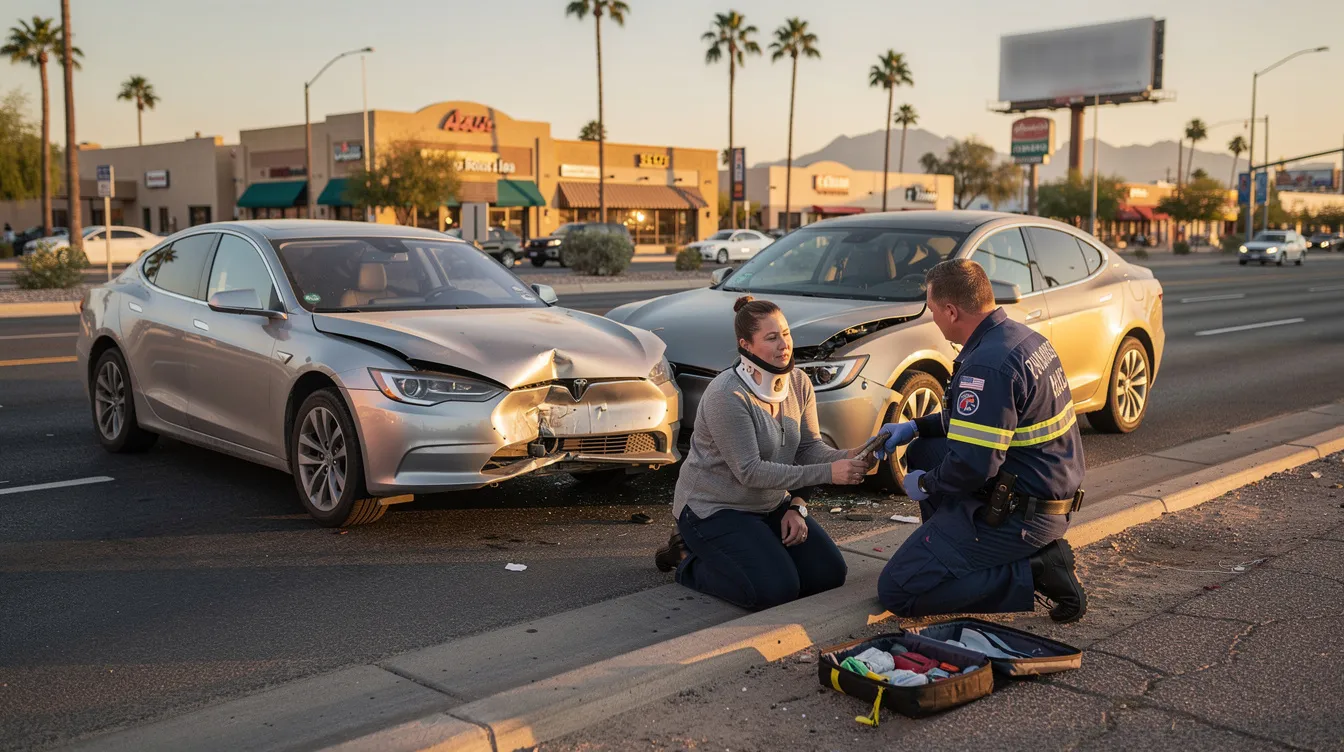
The Challenge of a Car Accident With an Uninsured Driver in Phoenix
A car accident can be stressful under any circumstances, but an accident with an uninsured driver in Phoenix often creates added uncertainty about how medical bills, vehicle repairs, and other losses will be paid. Many accident victims assume that without an at fault driver’s insurance, there are no meaningful options for recovery. In reality, Arizona law provides several potential paths, but each requires careful navigation. According to the Insurance Information Institute, approximately 11.8% of drivers in Arizona are uninsured, meaning that more than one in ten drivers may not have coverage in a car accident.
Working with a Phoenix uninsured motorist lawyer can help clarify those options. In Arizona’s fault-based system, the driver responsible for the crash is legally liable for damages. However, when the other driver lacks coverage, your own insurance policy, specifically uninsured motorist coverage, may become the primary source of compensation. Understanding how these claims work is essential to protecting your rights after a motor vehicle accident.
Why Hire a Phoenix Uninsured Motorist Lawyer
Uninsured motorist claims are often more complex than standard personal injury claims because you are effectively dealing with your own insurance company. While your own insurer is expected to handle your claim fairly, disputes can still arise over liability, injuries, and the value of damages.
A lawyer with experience in uninsured motorist claims can assist in several key scenarios:
- When the insurance company disputes fault or argues that your injuries are unrelated to the accident
- When the insurer undervalues medical expenses, lost wages, or other damages
- When arbitration or litigation becomes necessary under your insurance contract
Harris Injury Law has over 16 years of experience handling personal injury matters across Arizona, including cases involving uninsured or underinsured drivers. Their legal team focuses on clear communication, helping clients understand the entire process while pursuing fair compensation under Arizona law.
Review Your Insurance Coverage and Your Own Insurance Company’s Duties
After an accident with an uninsured driver, your own insurance policy becomes a central part of your car accident personal injury claim. It is important to review your insurance coverage carefully.
Start by identifying:
- Uninsured motorist coverage and underinsured motorist coverage limits
- MedPay or medical payments coverage for immediate medical costs
- Collision coverage for property damage
You should also locate any exclusions, notice requirements, and arbitration clauses within your insurance policy. Many policies require prompt notice, sometimes within 30 days, to preserve your right to file uninsured motorist claims.
According to the Arizona Department of Insurance and Financial Institutions, uninsured motorist coverage is optional in Arizona but strongly recommended due to the number of uninsured drivers on the road. Your own insurer has a duty to investigate your claim and evaluate damages in good faith, but you must comply with policy requirements to maintain eligibility.
How Uninsured or Underinsured Claims Work After a Car Accident
When an accident involves an uninsured or underinsured motorist, the claim process shifts. Instead of pursuing compensation solely from the at fault driver, you may file a claim with your own insurance company.
Here is how the process typically works:
- You report the accident and file a claim under your uninsured motorist coverage
- Your insurer evaluates liability, damages, and policy limits
- If the other driver has partial coverage, underinsured motorist coverage may apply after their policy’s limits are exhausted
Arizona also allows certain stacking options depending on your policy language and whether multiple insurance policies apply. This can increase the total coverage available in some situations.
For example, if your medical bills and lost income exceed the other driver’s minimal coverage or if they have no coverage at all, your own insurance provider may step in up to the policy’s limits. This is why understanding what your policy covers is critical.
Recoverable Damages in Arizona Auto Insurance Claims
Even when the at fault driver is uninsured, accident victims in Arizona can still pursue a wide range of damages through uninsured motorist claims.
Economic damages may include:
- Medical bills and ongoing medical treatment
- Lost wages and reduced earning capacity
- Property damage and vehicle repair costs
- Funeral costs in fatal accident cases
Non-economic damages may include:
- Pain and suffering
- Emotional distress
- Loss of quality of life
Arizona law allows recovery of both economic and non-economic damages in personal injury claims. According to Arizona Judicial Branch, these damages are evaluated based on evidence, documentation, and the overall impact of the injuries on your life.
Proving Fault When the At-Fault Driver Is Uninsured
Even though the other driver lacks insurance, you still need to prove that their negligence caused the crash. Arizona follows a comparative negligence system, meaning your compensation may be reduced if you share fault.
To build a strong claim, gather:
- Police reports documenting the accident
- Witness statements and contact information
- Photos of the crash scene, vehicle damage, and injuries
- Medical records detailing diagnosis and treatment timelines
Establishing that the at fault driver’s negligence caused the collision is essential for both uninsured motorist claims and any potential personal injury lawsuit.
Handling Pushback From Your Insurance Company
It may seem counterintuitive, but your own insurance company can challenge your claim. Common tactics include:
- Questioning the severity of injuries
- Arguing that medical treatment was unnecessary
- Disputing the value of damages
You should avoid giving recorded statements without understanding your rights. If disputes arise, your lawyer may recommend escalating the matter through arbitration or litigation, depending on your insurance contract.
The National Association of Insurance Commissioners provides guidance on insurer obligations, emphasizing that insurers must act in good faith when handling claims.
When to Sue the At-Fault Driver Versus Filing With Your Own Insurance
In some cases, pursuing a personal injury lawsuit against the uninsured driver may still be an option. However, this depends largely on collectability.
Key considerations include:
- Whether the uninsured driver has personal assets
- Whether additional liable parties exist, such as employers or employers in a work-related crash who may be responsible through workers’ compensation
- Whether product liability or third-party claims apply
If the uninsured driver lacks assets, pursuing compensation through your own insurance policy may be the more practical path. A lawyer can help evaluate which approach aligns with your circumstances.
Investigation, Evidence, and Use of Experts in Car Accidents
A thorough investigation strengthens your claim. Important steps include:
- Photographing the accident scene and vehicle damage immediately
- Preserving physical evidence such as damaged parts
- Subpoenaing traffic camera footage or phone records when relevant
- Consulting accident reconstruction experts to analyze fault
- Working with medical experts to document long-term injuries
These efforts help demonstrate how the crash occurred and support the value of your claim.
Timeline, Deadlines, and Statute of Limitations in Arizona
Timing is critical in uninsured motorist claims. Under Arizona Revised Statutes § 12-542, the statute of limitations for most personal injury claims in Arizona is two years from the date of the accident.
However, uninsured motorist claims may have shorter deadlines based on your insurance policy. Some policies require notice within 30 days, and arbitration provisions may impose additional timelines.
Failing to meet these deadlines can result in losing your right to pursue compensation. This is why early legal guidance is important.
Fees, Contingency Agreements, and Free Consultation
Most personal injury lawyers in Arizona work on a contingency fee basis. This means:
- Payment is only required if compensation is obtained on your behalf, as outlined in your fee agreement
- Fees are typically a percentage of the recovery
- Case expenses are usually paid from the recovery if one is obtained
Harris Injury Law offers contingency fee arrangements to help clients access legal services without paying upfront. This structure can reduce financial barriers while allowing accident victims to pursue their claims.
Preparing for a Free Consultation With a Phoenix Uninsured Motorist Lawyer
To make the most of your free consultation, gather the following:
- Police reports and accident documentation
- Photos and videos of the crash scene
- Medical records and bills
- Communication from your insurance company
- A timeline of events leading up to and following the accident
Providing this information allows your lawyer to evaluate your claim and outline next steps more effectively.
Contact a Phoenix Auto Accident Attorney for Uninsured Drivers Today
If you have been injured in an accident with an uninsured driver in Phoenix, you still have legal options. Understanding your insurance coverage, documenting your injuries, and acting within required deadlines can all impact your ability to recover compensation.
Harris Injury Law is available to help you explore your legal options under Arizona law. Their legal team has a long history of handling personal injury claims involving uninsured or underinsured drivers and can guide you through the entire process with clear communication.
To get started, schedule a free consultation and request a case evaluation by calling (480) 800-4878. Taking action early can help preserve your rights and provide a clearer path forward after a serious car accident.