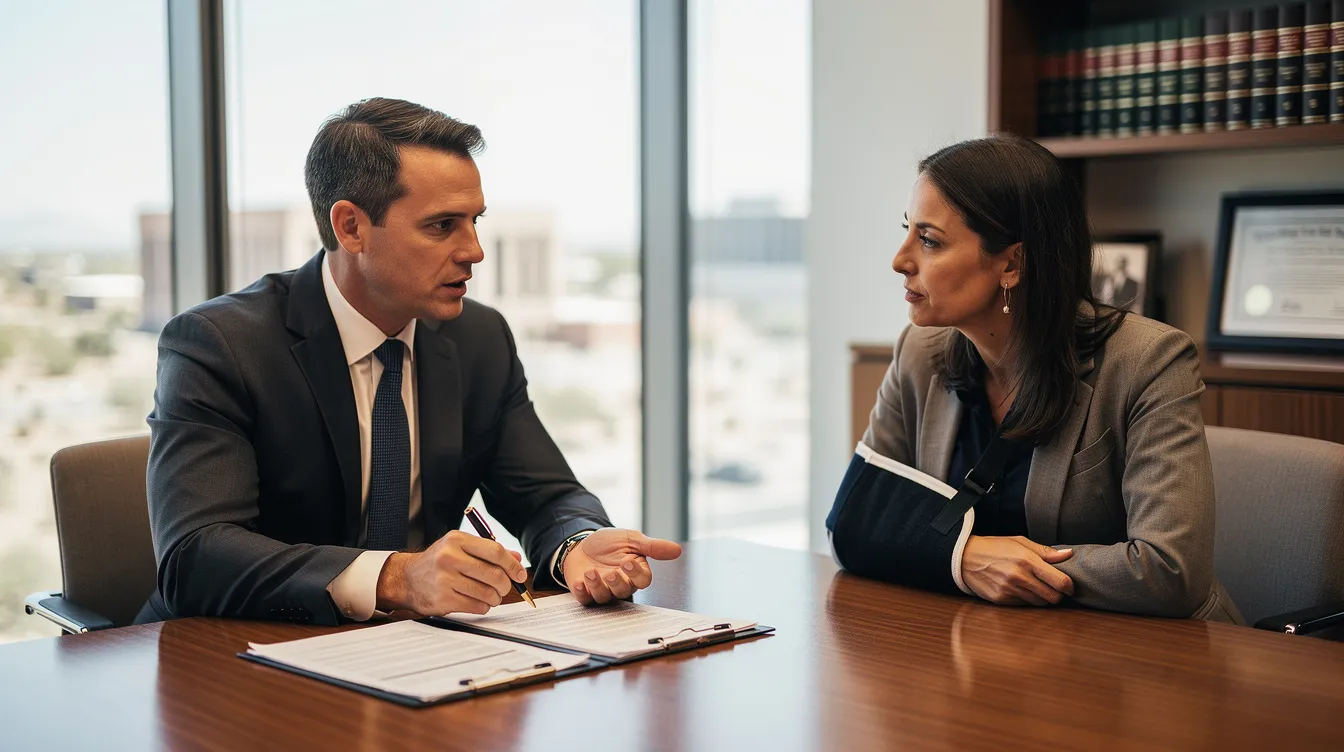
How a Phoenix Personal Injury Lawyer Proves Fault in Your Case
Snapshot: How Phoenix Personal Injury Lawyers Establish Liability
Data published by the Arizona Department of Transportation (ADOT) shows that thousands of injury crashes occur across Arizona each year, highlighting the importance of understanding how fault is determined after an accident.
When an accident disrupts your life, one of the most important legal questions becomes who is responsible. In Arizona, the answer to that question determines whether injured parties can pursue compensation for medical expenses, lost wages, and other damages. Proving fault is therefore central to every personal injury claim.
A Phoenix personal injury lawyer begins by carefully investigating how the accident occurred, identifying the at fault party, and collecting the key evidence needed to demonstrate negligence. This process often involves reviewing police reports, analyzing physical evidence, obtaining medical records, and interviewing witnesses.
Arizona is a fault-based insurance state, meaning the party responsible for causing the accident must pay for resulting damages. If someone else’s negligence caused the accident, the injured person may file a claim with the other driver’s insurance company or the responsible party’s insurer.
The goal of a personal injury investigation is to gather evidence relevant to liability and damages and to pursue the client’s claims through settlement discussions or litigation when appropriate. Results depend on the facts, available evidence, and applicable law.
Early investigation can be important in some cases because evidence such as video footage, vehicle data, and witness recollections may become harder to obtain over time.
Understanding a Phoenix Personal Injury Case Under Arizona Law
Most Arizona personal injury claims are based on negligence. This legal concept requires proof that another party failed to exercise reasonable care and caused harm.
Arizona follows a pure comparative negligence system under Arizona Revised Statutes § 12‑2505.
Under this rule, a person can still recover damages even if they were partially responsible for the accident. However, their compensation is reduced by their percentage of fault.
For example:
- If a jury determines you are 20 percent responsible for an accident
- Your compensation would be reduced by 20 percent
This rule plays a major role in proving fault and negotiating settlements.
Another important rule is the statute of limitations. Under Arizona Revised Statutes § 12‑542, most personal injury lawsuits must be filed within two years of the date of injury. Missing this deadline can prevent injured parties from pursuing compensation, regardless of how strong their case may be.
Early legal guidance may help preserve evidence, identify deadlines, and improve case preparation, depending on the facts of the matter.
How Phoenix Personal Injury Lawyers Build Strong Personal Injury Claims
A strong personal injury claim rarely happens by accident. It is the result of a structured investigation and legal strategy designed to uncover evidence and establish fault.
Most Phoenix personal injury lawyers begin with three core objectives:
- Identify all involved parties who may be legally responsible.
- Gather evidence quickly before it disappears.
- Document damages through medical treatment and financial records.
This investigation often includes reviewing surveillance footage, securing police reports, and sending evidence preservation letters to prevent the destruction of digital data or security footage.
For example, in a car accident investigation, attorneys may seek electronic data from a vehicle’s Event Data Recorder. These devices can provide information about speed, braking patterns, and seatbelt use before the collision.
This early investigation helps lawyers develop the legal strategy and evidence needed to evaluate and prepare a personal injury claim.
The Elements of Negligence in Arizona Personal Injury Law
To prove negligence in an Arizona personal injury lawsuit, four legal elements must be established.
1. Duty of Care
2. Breach of Duty
3. Causation
4. Damages
Each element must be supported by credible evidence.
The burden of proof lies with the plaintiff. This means the injured party must demonstrate that it is more likely than not that the defendant caused the harm.
If any one of these elements cannot be proven, the case may fail.
Understanding how these elements work together helps explain why gathering evidence is so important in personal injury litigation.
Duty of Care in Phoenix Personal Injury Cases
The first step in establishing fault is proving that the defendant owed a legal duty to the injured party.
In everyday life, many activities carry a legal obligation to act with reasonable care.
Examples include:
- Drivers must operate vehicles safely to avoid harming others.
- A property owner must maintain reasonably safe premises for visitors.
- Businesses must correct dangerous conditions that could harm customers.
These responsibilities form the basis of legal duty.
Arizona courts have reinforced these obligations in multiple rulings. In
Perez v. Circle K, the Arizona Supreme Court clarified that property owners may still owe a duty of care even when hazards are considered open and obvious.
This decision significantly influences premises liability cases in Phoenix.
Breach of Duty and the Standard of Care
Once duty is established, attorneys must demonstrate that the defendant breached that duty.
A breach occurs when someone fails to act with the level of reasonable care expected in a similar situation.
Examples include:
- A driver texting while driving
- A store failing to clean a spill
- Ignoring safety protocols at a construction site
- Violating traffic laws
In legal terms, this means the defendant breached the standard of care expected of a reasonable person.
Evidence used to demonstrate breach may include:
- Surveillance footage
- Maintenance records
- Witness statements
- Traffic citations
- Safety violation reports
Establishing breach is a critical step in proving that another person’s negligence caused the accident.
Causation: Linking the Breach to Your Injuries
According to the National Highway Traffic Safety Administration (NHTSA), driver behaviors such as speeding, impaired driving, and distracted driving remain leading contributors to serious injury crashes across the United States.
After proving a breach occurred, lawyers must demonstrate that the breach caused the injury.
This step is known as causation.
Two components must typically be shown:
Actual cause: the injury would not have occurred without the defendant’s actions.
Proximate cause: the harm was a foreseeable result of those actions.
For example, if an other driver runs a red light and causes an auto accident, causation may be demonstrated through traffic camera footage and accident reconstructionists.
Medical documentation also plays an important role in causation.
Lawyers often rely on medical experts and treating physicians to connect the injuries to the accident event.
Damages: Documenting Economic and Non-Economic Losses
Research from the Centers for Disease Control and Prevention (CDC) shows that motor vehicle crashes remain one of the leading causes of injury in the United States, often resulting in significant medical treatment and long-term financial consequences.
The final element of negligence is proving damages.
In Arizona personal injury law, damages refer to the measurable harm suffered by the injured party.
Common damages include:
Economic damages
- Medical expenses
- Medical bills
- Future medical costs
- Lost wages
- Property damage
Non-economic damages
- Pain and suffering
- Emotional distress
- Loss of enjoyment of life
Arizona does not impose a general cap on non-economic damages in most injury cases.
Documenting the full extent of damages is critical when seeking a fair settlement.

Gathering Evidence and Preserving Proof for Your Injury Claim
Evidence forms the foundation of any personal injury case.
Without evidence, even a valid claim may be difficult to prove.
A Phoenix law firm often begins evidence collection immediately after being retained.
The most important forms of evidence include:
- Police reports
- Medical records
- Photographs of the accident scene
- Witness testimony
- Surveillance footage
- Vehicle damage analysis
Because evidence can disappear quickly, lawyers often send spoliation letters to preserve surveillance footage or electronic records.
Early investigation can help preserve relevant evidence and strengthen case preparation.
Physical Evidence and Scene Documentation
Physical evidence provides objective proof of what happened during the incident.
Examples include:
- Skid marks
- Broken vehicle parts
- Road debris
- Damage patterns on vehicles
- Environmental conditions
Photos taken at the accident scene can reveal key information about visibility, lighting, and road design.
This evidence can help attorneys reconstruct how the accident occurred.
Documentary Evidence and Digital Forensics
Modern personal injury claims frequently rely on digital evidence.
Important sources include:
- Dashcam footage
- Security cameras
- Vehicle electronic data
- GPS records
- Cell phone data
Police investigations often generate detailed police reports that summarize the accident, list involved parties, and document early observations from responding officers.
These reports often form an important starting point in proving fault.
Medical Records and Expert Medical Opinions
Medical documentation is essential for proving both injury and causation.
Doctors, specialists, and other medical professionals create records that describe the nature and severity of injuries.
These records may include:
- Emergency room reports
- Diagnostic imaging
- Treatment notes
- Rehabilitation records
These medical records establish the treatment timeline and demonstrate the medical costs associated with the injury.
In complex cases, medical experts may testify about long-term care needs and future medical expenses.
Witness Testimony and Eyewitness Credibility
Third-party witnesses can play a powerful role in establishing liability.
Witness testimony can clarify:
- How the accident occurred
- Which driver had the right of way
- Whether safety violations occurred
Third-party witness statements can be important evidence, and their credibility depends on the circumstances.
Lawyers frequently collect witness statements soon after the incident to preserve accurate recollections.

Expert Witnesses and Accident Reconstruction
In complex cases, attorneys rely on expert analysis.
Experts may include:
- Accident reconstructionists
- Medical experts
- Engineering specialists
- Economic experts
Accident reconstruction professionals analyze collision dynamics, vehicle damage, and physical evidence to determine how the crash likely occurred.
Their testimony can be critical in cases involving disputed liability.
Comparative Fault and Disputed Liability in Arizona
Insurance companies frequently attempt to shift blame onto injured parties.
This tactic is common because Arizona’s pure comparative negligence system reduces compensation based on fault percentage.
For example:
- If the injured party is 30 percent responsible
- Their financial recovery is reduced by 30 percent
Phoenix attorneys often respond by presenting evidence that minimizes the client’s assigned fault.
Attorneys often respond by presenting evidence and legal arguments addressing disputed fault allegations.
The goal is to present evidence and legal arguments regarding how responsibility should be allocated.
Common Challenges in Phoenix Personal Injury Cases
Many personal injury victims face obstacles when attempting to prove fault.
Common challenges include:
Lack of Witnesses
When no witnesses exist, lawyers rely on physical evidence and expert reconstruction.
Pre-Existing Medical Conditions
Defense attorneys often argue that injuries existed before the accident.
Lawyers counter this claim by reviewing medical records and consulting medical experts.
Insurance Company Tactics
Insurance adjusters sometimes dispute liability or minimize injuries.
Strong documentation and expert testimony may be used to address these types of arguments.
The Role of Harris Injury Law in Phoenix Personal Injury Cases
A knowledgeable legal team can help evaluate claims, gather evidence, and guide clients through the claims process.
At Harris Injury Law, attorneys combine experience in both personal injury and workers’ compensation law to evaluate claims from multiple legal angles.
The firm’s experienced attorneys investigate incidents thoroughly and focus on building cases supported by strong documentation and expert testimony.
Clients working with a Phoenix personal injury lawyer at Harris Injury Law receive assistance with:
- Investigating liability
- Obtaining medical records
- Communicating with insurance companies
- Managing settlement negotiations
- Preparing cases for litigation if necessary
You can learn more about these services by visiting the firm’s page for a Phoenix personal injury lawyer.
Negotiation Strategies and Settlement Preparation
Many personal injury cases resolve through settlement negotiations rather than trial.
Attorneys prepare detailed demand packages that include:
- Medical documentation
- Financial loss calculations
- Evidence demonstrating liability
These packages are presented to the driver’s insurance company or the other driver’s insurance company.
Strong evidence may influence settlement discussions with insurance companies.
However, if negotiations fail, the case may proceed to a personal injury lawsuit.
Trial Preparation and Litigation
When a settlement cannot be reached, attorneys prepare the case for court.
This process may include:
- Filing legal pleadings
- Conducting depositions
- Consulting expert witnesses
- Preparing exhibits for trial
Evidence collected during the investigation becomes central to courtroom arguments.
The objective is to demonstrate that the defendant’s negligence caused the injuries.
What Clients Should Provide Their Personal Injury Lawyer
Clients can help strengthen their injury claim by providing documentation early.
Important materials include:
- Photos of injuries and property damage
- Copies of medical bills
- Contact information for witnesses
- Insurance correspondence
- Proof of lost wages
Keeping a daily journal describing pain levels, treatment progress, and limitations can also help demonstrate the impact of the injury.
Next Steps After an Accident in Phoenix
If you have been injured due to someone else’s negligence, several steps can help protect your rights.
First, report the incident and seek immediate medical treatment.
Second, gather information from the accident scene, including photographs and contact details for witnesses.
Third, avoid giving recorded statements to the other driver’s insurance company without legal advice.
Finally, consult an experienced personal injury attorney as soon as possible.
Early legal representation may help preserve evidence and support case development.
Conclusion: How Phoenix Personal Injury Lawyers Prove Fault Effectively
Proving fault in an Arizona personal injury case requires careful investigation, strong documentation, and a strategic legal approach.
Phoenix attorneys establish liability by:
- Demonstrating the defendant owed a duty of care
- Showing the defendant breached that duty
- Linking the breach to the injury through medical and expert evidence
- Documenting damages such as medical expenses and lost income
Evidence such as police reports, medical records, witness testimony, and expert analysis is often important in personal injury claims.
Insurance companies often attempt to minimize payouts or shift blame. A legal team can help injured parties navigate the legal process and pursue available compensation supported by the facts and law.
If you or a loved one has been injured in Phoenix due to someone else’s negligence, consulting a knowledgeable attorney may help you understand your rights and options.
Harris Injury Law offers a free consultation at (480) 800-4878 to discuss your situation and explain potential legal options.