Skip to content

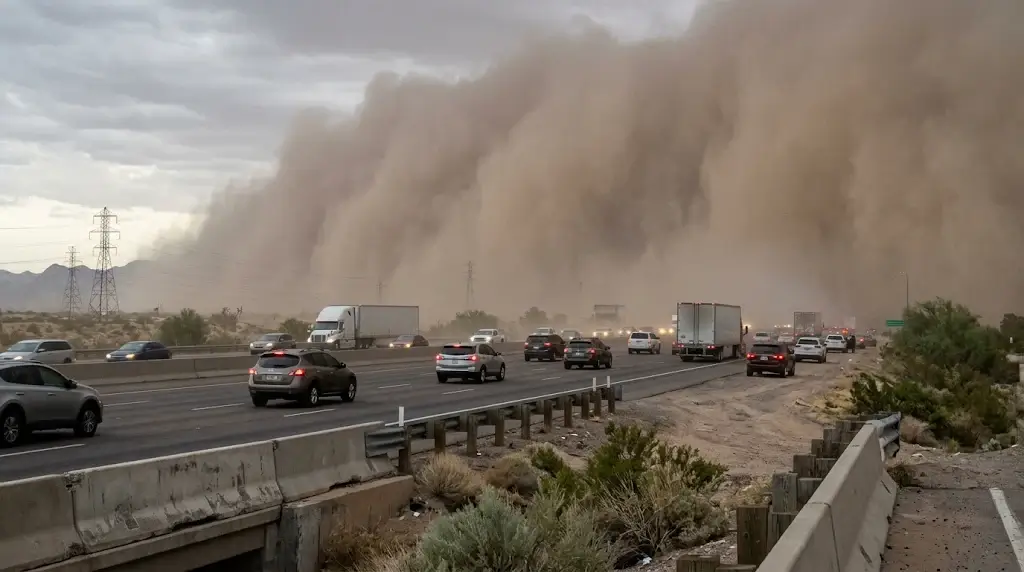
A dust storm can turn a Phoenix highway into a dangerous stretch of near-zero visibility. But bad weather does not automatically excuse a driver who causes a crash. A Phoenix car accident attorney can examine whether a driver ignored warnings, failed to reduce speed, or followed too closely. Arizona law requires drivers to adjust their conduct to actual road conditions. That rule matters during haboobs, monsoon storms, and sudden dust channels. If you need broader guidance after a collision, visit our Phoenix car accident lawyer page.
Who Is at Fault in a Dust Storm Car Accident in Arizona?
The driver whose careless decisions contributed to the crash may be legally responsible. A dust storm does not remove a driver’s duty to use reasonable care. Investigators must examine what each driver knew, when visibility changed, and how each person responded.
For example, one driver may enter a visible dust wall without slowing down. Another may follow too closely behind a vehicle that suddenly stops. A third may lose control after visibility drops. Each driver’s conduct requires a separate review.
The key issue is not simply whether dust caused poor visibility. It is whether a driver’s actions helped cause the collision. Evidence may show that a driver had time to slow down, leave the highway, or avoid entering dangerous conditions.
Arizona law also considers whether the weather created a hazard that drivers could reasonably anticipate. A sudden change in visibility may affect the analysis. It does not automatically settle the question of fault.
Does a Dust Storm Automatically Qualify as an Act of God?
No. A dust storm does not automatically protect a negligent driver from responsibility. Arizona courts have addressed this issue in a case involving a severe dust-storm collision.
In Arnold v. Frigid Food Express Co., 9 Ariz. App. 472, 453 P.2d 983 (1969), thirteen vehicles collided during a severe dust storm near Picacho. The Arizona Court of Appeals held that an “act of God” instruction was improper in a negligence case. The court ordered a new trial because the evidence did not establish that the accident happened without negligence.
The decision does not mean every driver in a dust storm is liable. It means weather alone does not erase possible negligence. A driver may still face responsibility for unreasonable speed, unsafe following distance, or other careless conduct.
The distinction matters in Phoenix. Monsoon outflows can send blowing dust across roads with little warning. Drivers must still respond reasonably to hazards they can see or should anticipate.
Can a Sudden Dust Channel Create a Sudden-Emergency Defense?
Yes, but only in limited circumstances. Arizona recognizes sudden emergency as one factor in deciding whether a driver acted reasonably. It does not provide automatic immunity.
In Myhaver v. Knutson, 189 Ariz. 286, 942 P.2d 445 (1997), the Arizona Supreme Court explained that courts should reserve the sudden-emergency instruction for rare cases. The emergency must arise from events the driver could not reasonably anticipate. The driver also must not have created the emergency through earlier negligence.
Consider a driver who encounters an unexpected dust channel across a highway. The driver may have only seconds to react. That situation differs from knowingly driving into a visible dust wall at an unsafe speed.
A court may consider the driver’s reaction, visibility, available escape routes, and earlier decisions. The emergency and the driver’s response remain part of the full negligence analysis.
What Do Arizona Car Accident Laws Say About Driving in Dust Storms?
Arizona law requires drivers to choose a speed that remains reasonable for current conditions. The posted speed limit does not guarantee that speed is safe.
Under A.R.S. § 28-701, drivers must control their speed according to actual and potential hazards. The statute specifically includes special hazards caused by weather or highway conditions. A driver may therefore act unreasonably while traveling below the posted limit.
This rule is central to Arizona car accident laws involving blowing dust. A driver approaching a dust wall may need to slow down or exit the highway. Continuing at highway speed may create an avoidable risk.
The same principle applies to the following distance. Under A.R.S. § 28-730, drivers must leave a reasonable distance based on speed, traffic, and highway conditions. Reduced visibility can make extra stopping room especially important.
Can Following Too Closely Cause a Dust-Storm Rear-End Collision?
Yes. A driver who leaves too little stopping distance may cause or contribute to a rear-end collision. Dust can sharply reduce the time available to recognize stopped traffic.
A driver approaching a dust cloud should not assume the vehicle ahead will keep moving. Traffic may slow or stop as visibility disappears. Tailgating leaves less room to respond.
Investigators should examine vehicle speeds, braking evidence, impact points, and the distance between vehicles. They should also consider whether the lead driver stopped safely or created another hazard.
A rear-end impact does not automatically prove that the following driver caused every injury. The full sequence matters, especially when several vehicles collide.
How Does Arizona Divide Fault After a Dust-Storm Crash?
Arizona may assign different percentages of fault to drivers who contributed to the same crash. A claimant’s damages generally decrease by the percentage of fault assigned to that claimant.
Under A.R.S. § 12-2505, comparative negligence does not automatically bar a claim. The factfinder reduces damages according to the claimant’s share of fault. The statute contains an exception for claimants who intentionally, willfully, or wantonly caused or contributed to the injury.
For example, a driver may have slowed down but still followed too closely. Another driver may have entered the dust cloud without reducing speed. A third may have stopped in an unsafe location. The evidence may support different fault percentages.
Under A.R.S. § 12-2506, each defendant generally pays only the share assigned to that defendant. The law includes limited exceptions, including certain agency or servant relationships.
This distinction can matter when a commercial vehicle or employer-related driver contributes to a crash. For more detail about multiple-vehicle fault, see our guide to fault in Arizona multi-car pileups.
What Evidence Helps Determine Fault After a Dust-Storm Crash?
The strongest evidence connects weather conditions to each driver’s actions and the collision sequence. A useful investigation examines what happened before, during, and after visibility disappeared.
Important evidence may include:
- Weather records: National Weather Service advisories, radar data, and wind observations can help establish storm timing and severity.
- ADOT camera footage: Available traffic-camera recordings may show roadway visibility and traffic conditions.
- Dashcam footage: Video may show when the dust arrived and how drivers responded.
- Event data recorders: Some vehicles store speed, braking, and other information around a collision.
- GPS and telematics: Commercial vehicle records may help establish location, movement, and timing.
- Police reports: Reports may document statements, road conditions, damage, and initial observations.
- Witness statements: Drivers and passengers may describe visibility, warnings, and the first impact.
- Physical evidence: Skid marks, debris, vehicle damage, and final positions may help explain the crash sequence.
Accident reconstruction can help connect these details. It may clarify the first impact and later collisions. It cannot guarantee a particular result.
A Phoenix-area example shows why accurate weather records matter. On August 19, 2026, the National Weather Service documented widespread wind gusts mainly between 55 and 65 mph. Blowing dust reduced visibility below one mile in several locations. Some East Valley areas recorded visibility below one-quarter mile. ADOT webcam images documented dense dust near Loop 202 and Power Road in East Mesa. These records describe that weather event. They do not prove that dust caused any particular collision.
Can a Commercial Truck Driver Be Responsible for Driving Through Dust?
Yes. Federal rules require covered commercial motor vehicle drivers to use extreme caution when dust reduces visibility or traction.
Under 49 C.F.R. § 392.14, drivers must reduce speed during hazardous conditions. If conditions become sufficiently dangerous, they must stop operating until they can drive safely. A passenger-safety exception allows movement to the nearest safe point when stopping would increase the danger.
Investigators may review truck speed, braking data, driver logs, GPS records, dispatch messages, and company safety policies. These records may help explain what the driver knew and when the driver received warnings.
The rule does not make a trucking company automatically liable. The facts, applicable duties, and relationship between the driver and company still matter.
When Can a Dust-Storm Crash Lead to a Phoenix Auto Accident Lawsuit?
A Phoenix auto accident lawsuit may follow when evidence supports a negligence claim and the parties cannot resolve the dispute. A lawsuit may involve one driver or several responsible parties.
The claim may seek damages for medical expenses, lost income, vehicle damage, and other losses allowed by law. Available insurance can affect what money a claimant may recover. Arizona’s minimum liability limits do not guarantee enough coverage for a serious collision.
Uninsured or underinsured motorist coverage may also matter when another driver lacks sufficient bodily injury coverage. Under A.R.S. § 20-259.01, UM and UIM coverage concerns bodily injury or death. It should not be confused with automatic coverage for vehicle damage.
A lawsuit is not necessary in every case. The right approach depends on the evidence, injuries, insurance policies, and disputed legal issues.
What Should Drivers Do When a Dust Storm Approaches?
Drivers should avoid entering a dust storm and leave the highway when they can do so safely. ADOT’s June 8, 2026 guidance repeats its Pull Aside, Stay Alive instructions.
If a storm approaches:
- Check traffic around your vehicle and begin slowing down.
- Exit the highway if you can do so safely.
- If you cannot exit, safely pull completely off the paved roadway.
- Do not stop in a travel lane or on the shoulder.
- Set the emergency brake and turn off all vehicle lights, including hazard flashers.
- Take your foot off the brake.
- Keep your seat belt fastened and wait for the storm to pass.
ADOT explains that approaching drivers may follow visible lights and strike a parked vehicle. Turning off the lights helps reduce that risk. Check ADOT’s 2026 dust-storm safety guidance for the full instructions.
Frequently Asked Questions
Does a Dust Storm Automatically Excuse a Driver?
No. A driver may still face liability if unreasonable conduct contributed to the crash. Weather conditions form part of the investigation.
Can a Driver Be Negligent Below the Speed Limit?
Yes. A.R.S. § 28-701 requires a reasonable speed under actual and potential hazards. A posted limit does not always represent a safe speed.
Can Multiple Drivers Share Fault After a Dust-Storm Pileup?
Yes. Arizona law allows the factfinder to assign fault among responsible drivers and other contributing persons. Each defendant’s liability generally reflects that defendant’s percentage of fault.
What Evidence Helps Prove Fault?
Weather records, camera footage, dashcams, vehicle data, witness statements, police reports, and physical evidence may help establish what happened.
Can a Sudden Dust Channel Create a Sudden-Emergency Defense?
Possibly. The emergency must be unexpected, and the driver must not have caused it through earlier negligence. The driver’s response must still be reasonable under the circumstances.
Discuss Your Dust-Storm Crash With Harris Injury Law
A dust-storm collision can raise difficult questions about speed, visibility, following distance, and shared fault. The evidence may also disappear or become harder to obtain over time.
Harris Injury Law represents injured people across Arizona. If you want to discuss a Phoenix-area dust-storm collision, call at (480) 800-4878 or you can request a consultation. The firm will review the circumstances and explain potential legal options.
This article provides general information, not legal advice. Reading it does not create an attorney-client relationship.
Reviewed by Jason A. Harris, Attorney, Harris Injury Law, PLLC.