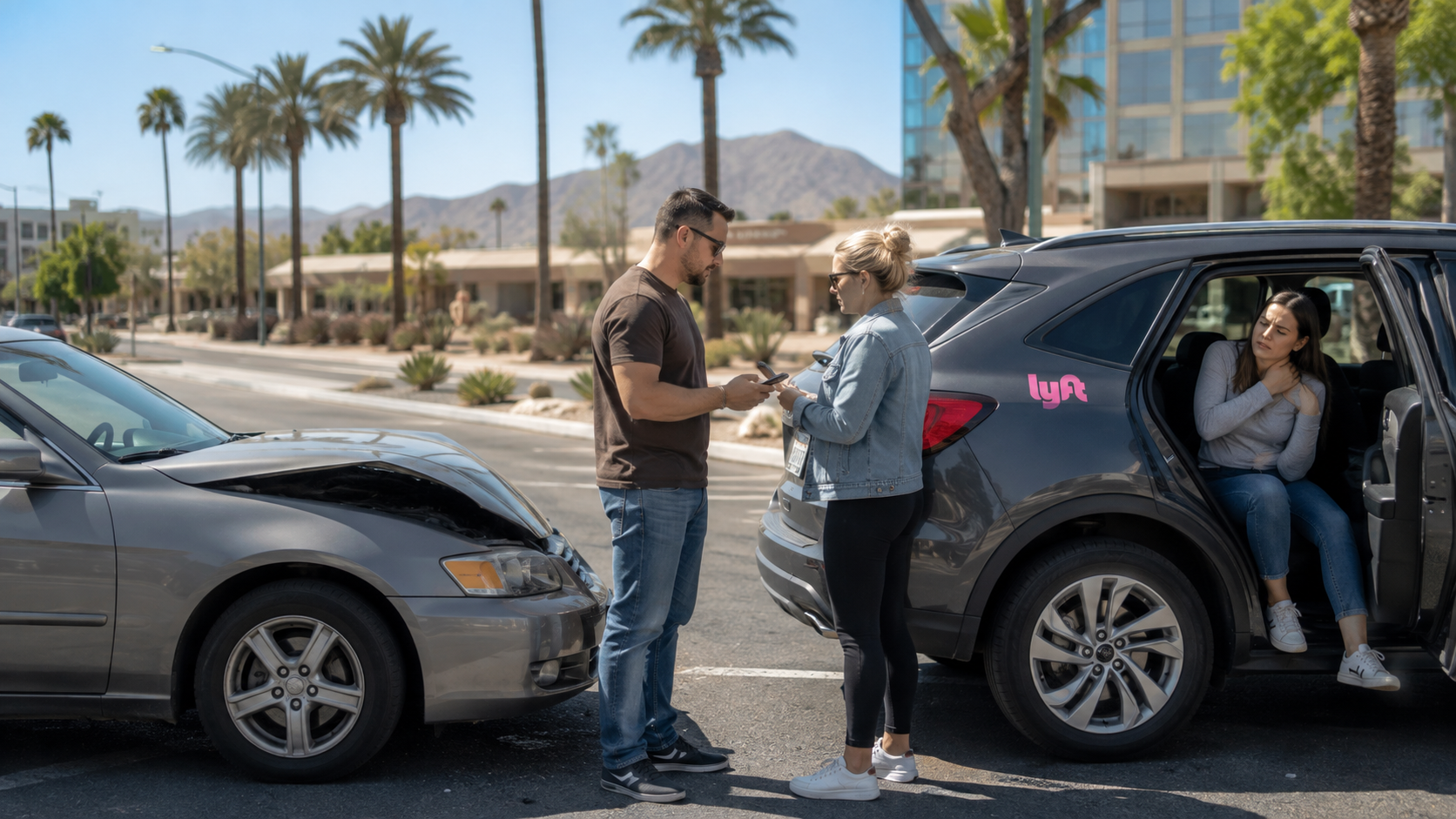
If an Uber driver hit you while logged into the app but before accepting a ride, you fell into “Period 1” a window where Uber’s insurance drops from $1 million to as little as $50,000, and pays only after the driver’s personal insurer denies the claim first. A Phoenix Uber accident lawyer can identify which period applies and pursue every policy that owes you compensation.
Most articles about Uber accidents in Phoenix focus on what happens once a passenger is in the car the easy case, where Uber’s $1 million policy applies and liability is straightforward. The harder case, and the one insurers count on victims not understanding, happens in the gap between shifts: when a driver has the app open, is cruising for a ping, and causes a wreck before ever accepting a fare.
What “Period 1” Means and Why It’s Different From a Normal Uber Crash
Uber and Arizona regulators divide every trip into four distinct insurance periods, and the coverage available to you depends entirely on which one the driver was in at the moment of the crash.
Period 0: App off. The driver isn’t logged into the app. Only their personal auto policy applies, and Uber has zero responsibility.
Period 1: App on, no ride accepted. The driver is logged in and available but hasn’t matched with a rider yet. This is the gap this article is about.
Period 2: En route to pickup. The driver has accepted a ride request and is driving to get the passenger.
Period 3: Trip in progress. A passenger is in the vehicle.
Periods 2 and 3 are treated almost identically for insurance purposes both are backed by Uber’s commercial policy of at least $1 million in combined liability coverage. Period 1 is the outlier, and it’s the one most Phoenix drivers, passengers, and pedestrians don’t realize applies to them until an adjuster explains why their claim is worth a fraction of what they expected.
How Much Coverage Actually Applies During Period 1
This is where the coverage gap becomes concrete. During Period 1, Uber’s own national policy provides contingent liability coverage of $50,000 per person, $100,000 per accident total for bodily injury, and $25,000 per accident for property damage.
Compare that to the $1 million available the moment a ride is accepted, and the drop is severe from seven figures to a combined limit a single serious injury claim can exhaust, let alone a multi-vehicle crash with several people hurt.
Arizona law, under A.R.S. § 28-4038, sets the statutory floor even lower for this period roughly $25,000 per person, $50,000 per accident, and $20,000 in property damage, mirroring the state’s general minimum financial responsibility limits. Uber voluntarily carries more than Arizona technically requires, but “more than the bare minimum” still isn’t enough to cover a fractured spine, a traumatic brain injury, or months of lost income the kinds of injuries we regularly see in Phoenix Uber cases along high-speed arterials like Camelback Road, I-17, and the Loop 202.
The Word That Trips People Up: “Contingent”
Uber’s Period 1 coverage isn’t primary it’s contingent. That single word explains most of the disputes we see in these claims.
Contingent coverage means Uber’s policy pays out only after the driver’s personal auto insurer has been billed and has denied the claim. That denial is almost guaranteed: most personal policies contain a livery or “transportation network company” exclusion that voids coverage the instant a rideshare app is open for hire, whether or not a passenger was in the car.
The sequence typically looks like this: you or your attorney file a claim with the at-fault driver’s personal insurer; that insurer investigates, discovers the app was on, and denies the claim citing the exclusion; only then does Uber’s contingent Period 1 policy become available, up to that reduced limit.
Each step takes time and gives an adjuster another chance to dispute facts, delay payment, or argue the driver was actually still in Period 0. Insurers on both sides have an incentive to point at each other, and claimants who don’t know this process exists often accept a lowball settlement from whichever company responds first.
Why This Matters More in Phoenix Than the National Uber Content Suggests
National Uber accident articles talk about Period 1 in the abstract. In Phoenix, it’s a daily reality tied to how rideshare driving actually works here. Drivers commonly log into the app before pulling out of a driveway in Ahwatukee, while sitting in a Sky Harbor staging lot waiting for a ping, or while running errands between fares near ASU or downtown Phoenix. That whole time, they’re legally “working” for Uber but the insurance backing them is a fraction of what most people assume.
That gap creates risk for more than just passengers. Other drivers and pedestrians face it if a Period 1 Uber driver runs a light on Van Buren Street or rear-ends someone on the I-10 while cruising for a fare the injured third party gets stuck with the reduced coverage through no fault of their own. Cyclists near downtown Phoenix, Mill Avenue in Tempe, and Sky Harbor face similar exposure, since those areas see heavy rideshare traffic circling for pickups. Even the Uber driver may need it: if an uninsured motorist causes the crash, they can rely on the uninsured/underinsured motorist coverage Arizona requires TNCs to offer coverage many drivers don’t know they can access.
The practical result is the same across all three groups: less money on the table, a more complicated dispute, and a thinner margin for error than in a standard Period 2 or 3 accident.
What to Do If You’re Hurt During Uber’s Coverage Gap
If you believe you were injured by a driver who had the Uber app on but hadn’t accepted a ride, a few early steps protect your claim:
- Get the police report and note the driver’s phone. Officers don’t always record app status, so ask that it be documented, and photograph the phone screen if it’s safely visible.
- Preserve the scene. Photos of vehicle positions, damage, and traffic signals can help establish when the app was active relative to the crash.
- Don’t accept the first number offered. An early offer may be based on a denial that hasn’t happened yet, or may undervalue the claim before Uber’s contingent policy is engaged.
- Request Uber’s trip and login data. These records show precisely when a driver went online, accepted a ride, and started a trip data that determines which period applies.
- Talk to a Phoenix Uber accident attorney before signing anything. Once you accept a settlement, you generally can’t ask for more if your injuries turn out worse than expected our guide to the Phoenix Uber accident lawsuit timeline walks through what comes next.
Why a Phoenix Uber Accident Attorney Matters for Period 1 Claims
Period 1 cases are harder than typical Uber claims because they involve two insurers pointing at each other, a contingent policy that only activates after a denial, and limits that are often inadequate for serious injuries. An experienced Uber accident attorney in Phoenix knows how to request the trip data proving which period applies, push past an automatic denial, and identify every available source of recovery when Uber’s limits fall short.
At Harris Injury Law, we’ve built our practice around understanding these distinctions, because the difference between a $50,000 policy and a $1 million policy can mean a settlement that covers your bills or one that doesn’t come close. If you were hurt by a rideshare driver anywhere in Phoenix passenger in the car or not we’ll investigate which coverage period applies and fight for full value.
Frequently Asked Questions
Does Uber cover accidents when the app is on but no ride has been accepted? Yes. Uber provides contingent liability coverage of $50,000 per person, $100,000 per accident, and $25,000 in property damage, but only after the driver’s personal auto insurer denies the claim first.
What if my personal auto insurance denies my claim after an Uber accident? A denial based on a livery or rideshare exclusion is common and expected in Period 1 cases. Once denied, Uber’s contingent policy becomes available, though the claim must still be documented and submitted properly to trigger it.
How much can I recover if I’m hit by an Uber driver who hadn’t accepted a ride yet? Recovery is generally capped at Uber’s Period 1 limits unless additional coverage applies, such as the at-fault driver’s personal umbrella policy or your own underinsured motorist protection.
Is Arizona’s minimum rideshare insurance requirement enough to cover serious injuries? Often not. Arizona’s statutory floor under A.R.S. § 28-4038 is even lower than what Uber actually carries, and both can fall far short of costs for surgery, hospitalization, or long-term care.
Do I need a lawyer for a Period 1 Uber accident claim in Phoenix? Given the contingent coverage structure, the two-insurer dispute process, and the reduced limits involved, working with a Phoenix Uber accident lawyer significantly improves your odds of full compensation instead of a rushed, partial settlement.
If you were injured by a rideshare driver in the Phoenix area and aren’t sure which coverage period applies, call Harris Injury Law at (480) 800-4878 for a free consultation, or request a consultation online. We’ll review the trip data, identify every applicable policy, and pursue the compensation this coverage gap makes easy for insurers to avoid paying.