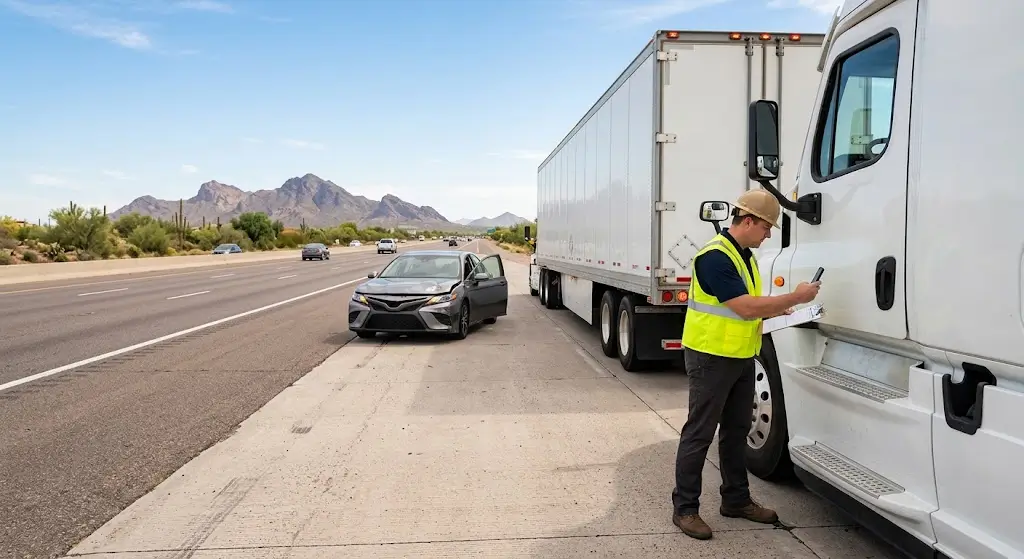
If you were injured in a Phoenix Uber crash, one of your first questions may be simple: how long does a Phoenix Uber accident lawsuit take? A Phoenix Uber accident lawyer can explain how rideshare accident claims move from medical care and insurance review to settlement negotiations, litigation, or trial.
Every case is different, and no timeline can be guaranteed. As a general planning estimate, some rideshare claims resolve within months, while litigated cases may take one to three years or longer depending on liability, insurance coverage, medical treatment, court scheduling, and settlement negotiations.
The timeline depends on several factors: the severity of Uber accident injuries, the number of insurance companies involved, the driver’s app status, the completeness of medical records, whether multiple parties dispute fault, and whether the case can resolve through a fair settlement before trial.
Phoenix adds its own practical complications. Rideshare accidents may happen near Sky Harbor, downtown Phoenix, I-10, Loop 202, Camelback Road, Scottsdale Road, or dense pickup zones where congestion, sudden stops, rideshare navigation, and passenger loading can make fault investigations more detailed.
Quick Timeline Estimate for a Phoenix Uber Accident Claim
A straightforward Uber accident claim with minor injuries, clear fault, complete medical bills, and cooperative insurers may resolve in one to three months after treatment and documentation are complete.
A moderate claim involving ongoing medical treatment, disputed fault, lost wages, and multiple insurance policies may take three to twelve months.
A serious personal injury lawsuit involving traumatic brain injuries, surgery, permanent impairment, contested rideshare insurance, or an insurance company refuses to make a reasonable offer may take one to three years or longer.
These ranges are not guarantees. They are practical planning estimates for accident victims trying to understand the legal proceedings ahead.
Immediate Steps After an Uber Accident in Phoenix
The first few hours after an accident in Phoenix can affect both your health and your injury claim.
Seek medical attention immediately, even if symptoms seem mild. Adrenaline can hide pain, and injuries such as concussions, soft tissue trauma, internal injuries, and traumatic brain injuries may not be obvious at the scene.
Prompt medical attention also creates records that connect your symptoms to the car crash. Insurance adjusters often question delays in treatment, so early documentation can help protect your claim.
Call law enforcement and ask for a police report if anyone is injured, vehicles are blocking traffic, or there is meaningful property damage. Uber’s own accident guidance tells drivers to contact police and paramedics when injuries or damage occur, save the report number, photograph damage, and report the crash through the app using the company’s crash reporting process. (Uber’s official insurance disclosure)
Report the crash to Uber through the app. If you were a passenger, save the ride receipt, route, driver name, trip time, pickup location, drop-off location, screenshots, and any message history.
Photograph the accident scene if it is safe. Capture vehicle positions, lane markings, traffic signs, rideshare pickup areas, skid marks, debris, weather, lighting, visible injuries, and vehicle damage.
Preserve Uber App Trip Data
Uber liability often depends on the driver’s status at the time of the crash.
Save your Uber ride receipt and trip details from the app. If you were not the passenger, ask the passenger to preserve the trip receipt and route if possible.
Uber drivers may receive a ride request through the app and have a limited response window. Uber’s help materials state that drivers have 15 seconds to decide whether to accept a request, which matters because app interaction, timing, route changes, and driver attention may become part of the investigation. (Uber Help)
Do not rely on Uber, an insurance provider, or the other driver to preserve everything automatically. Screenshots, receipts, and early preservation requests can prevent gaps later.
Gathering Evidence and Medical Records
Evidence collection can take months, especially when a rideshare company, a driver’s personal insurance, Uber’s insurance, and other insurers disagree about coverage.
Start with your medical records. Ask each medical provider for treatment dates, diagnosis codes, imaging reports, discharge summaries, physical therapy notes, prescriptions, and referrals.
Request medical bills separately. Billing departments often keep itemized charges apart from clinical records, and both are usually needed to prove medical expenses.
Collect witness contact information. Independent witnesses may help explain what happened before memories fade or phone numbers change.
Save repair estimates, towing invoices, rental car receipts, rideshare receipts, wage records, and photos of your damaged property. Compensation can include property damage from the accident, not only physical injuries.
Medical Records Checklist for Uber Accident Claims
Use this checklist to organize your claim file before meeting a rideshare accident lawyer or law firm.
Include the date of every medical visit, the provider name, the facility name, and the reason for each appointment.
Keep emergency room records, urgent care notes, primary care records, specialist evaluations, physical therapy notes, chiropractic records if applicable, and pain management records.
Include imaging reports such as X-rays, CT scans, MRIs, ultrasound studies, and radiology interpretations.
Keep itemized bills, explanation of benefits forms, health insurance lien notices, prescription receipts, mileage to medical appointments, and out-of-pocket receipts.
Also keep work records showing missed time, reduced hours, job restrictions, and lost wages if your injuries prevented you from working.
Insurance, Multiple Parties, and Rideshare Insurance Claims
Uber crashes are different from ordinary car accident claims because the applicable insurance coverage can change minute by minute.
If the Uber driver was offline, only the driver’s personal auto insurance generally applies. In that situation, the claim may look more like a standard auto accident claim against an at-fault driver.
If the driver was online and available but had not accepted a ride, Uber’s current public insurance disclosure states that third-party liability coverage may provide at least $50,000 per person, $100,000 per accident for injuries, and $25,000 for property damage.
If the driver accepted a ride and was en route to pick up a passenger, Uber’s insurance may provide at least $1 million for injuries and property damage involving riders and third parties.
If a passenger was in the Uber vehicle, Uber’s insurance also generally provides at least $1 million in liability coverage when the Uber driver is at fault.
Arizona law also has state-specific transportation network company requirements. Under Arizona Revised Statutes Section 28-4038, coverage requirements depend on whether the transportation network company driver is logged into the app, available, or providing transportation network services, and the TNC and insurers must cooperate in exchanging app-status and coverage information after a crash.
That is why an Uber accident claim often involves more than one insurance policy. It may involve the Uber driver, the driver’s personal insurance, Uber’s insurance, another negligent driver, the rideshare company, a vehicle owner, a commercial carrier, a government entity, or a roadway contractor.
Arizona Is a Fault-Based State
Arizona is a fault state, meaning the crash-causing party is generally responsible for the harm caused by the collision.
In a Phoenix rideshare crash, fault may rest with the Uber driver, another driver, both drivers, a vehicle owner, a company responsible for maintenance, or another party.
Multiple parties can be liable in Uber accidents, including Uber in some circumstances depending on the facts, app status, insurance policy, and legal theory involved.
This is one reason rideshare accidents often move slower than a routine rear-end collision. Negotiating with multiple insurance companies usually takes longer than dealing with a single insurer.
Do Not Give Recorded Statements Without Legal Advice
Insurance adjusters may ask for a recorded statement shortly after the crash.
Be careful. Do not give recorded statements to Uber’s insurance, the driver’s insurer, or another insurance company without legal guidance.
Even simple statements about speed, pain level, or what you remember can be used later to dispute liability or damages.
You should still report the crash as required and cooperate with reasonable claim procedures, but you do not need to guess, minimize symptoms, or accept blame.
When to Contact a Phoenix Uber Accident Lawyer or Law Firm
You should consider contacting an Uber accident lawyer early if you were injured, missed work, received medical care, or are unsure which insurer applies.
Early legal guidance can help preserve app data, identify coverage, communicate with insurers, and monitor deadlines.
A Phoenix car accident lawyer can also evaluate whether the matter should remain an insurance claim or become a formal lawsuit.
Bring initial medical records, medical bills, the police report number, Uber trip screenshots, insurance correspondence, photos, witness details, and any employer documentation showing lost wages.
During a consultation, ask how the contingency fee works. In many personal injury cases, attorney fees are owed only if compensation is obtained, but case costs, expenses, percentages, and deduction methods are governed by the written fee agreement. The agreement should explain what fees and expenses may apply and when they may be owed.
Harris Injury Law’s Rideshare Case Approach
Harris Injury Law represents clients in a wide range of personal injury cases, including rideshare accident claims, car accident case matters, and injury claims involving multiple insurance layers.
Attorney Jason Harris has experience in personal injury and workers’ compensation matters. This background may be relevant in cases involving work-related travel, commercial driving, or third-party liability issues.
The firm’s process focuses on identifying available insurance coverage, collecting medical documentation, handling communications with insurance companies, and preparing for litigation if needed.
For people comparing options, the practical question is not whether someone is a “skilled attorney” in a vague sense. The better question is whether the lawyer has experience handling accident claims involving app-status disputes, multiple insurance policies, serious injuries, and Phoenix-area litigation procedures.
Timeline Breakdown: Investigation, Filing, Discovery, and Settlement
Most Uber accident cases begin with investigation.
This phase often takes one to four months, depending on how quickly evidence becomes available. A lawyer may request the police report, obtain medical records, contact witnesses, preserve Uber app data, review photos, and identify every insurance policy.
If liability is clear and treatment is short, settlement negotiations may begin after the claimant finishes treatment or reaches a stable point.
If injuries continue, the case may wait until doctors understand the long-term prognosis. This avoids settling before future care costs, impairment, and pain and suffering are reasonably known.
If settlement negotiations fail, a formal lawsuit may be filed in the Maricopa County Superior Court when the amount and case type belong there. The court explains that civil cases over $10,000 fall within Superior Court jurisdiction and that attorney-filed documents are generally filed electronically.
Arizona Filing Deadlines
Arizona generally allows two years to file a personal injury lawsuit for injuries to a person. The deadline is stated in Arizona Revised Statutes Section 12-542.
Missing the two-year statute of limitations can result in case dismissal, even if the injuries are serious.
There is an important exception for claims involving public entities. If a government entity, public employee, public vehicle, roadway defect, city contractor, or public transit-related issue may be involved, a Notice of Claim may be required within 180 days under Arizona Revised Statutes Section 12-821.01.
Consulting a lawyer early helps protect filing deadlines and avoids waiting until evidence is difficult to obtain.
Discovery Usually Adds Six to Nine Months
After a lawsuit is filed, the parties exchange information through discovery.
The process of exchanging evidence and interviewing witnesses during discovery usually takes six to nine months, although complex cases may take longer.
Discovery may include written questions, document requests, subpoenas, depositions, expert disclosures, medical record exchanges, and insurance policy production.
Depositions are sworn testimony sessions. The injured person, Uber driver, other drivers, witnesses, medical providers, investigating officers, or expert witnesses may be questioned.
Discovery, Negotiation, and Settlement: The Role of Medical Treatment
Ongoing medical care is one of the biggest timing factors in an Uber accident lawsuit.
If you are still treating, your lawyer may not know the full value of your damages yet. A quick settlement agreement could leave out future surgery, therapy, injections, work restrictions, or long-term pain management.
Maximum medical improvement is the point where a person’s condition cannot be improved further through additional treatment. It does not always mean the person is fully healed. It means the medical condition has stabilized enough for doctors to evaluate long-term limitations.
Early expert medical prognosis can help move the case forward. Treating doctors, specialists, life care planners, vocational experts, and economists may help estimate future care costs, future lost wages, and long-term impairment.
Medical liens should also be addressed before settlement. Hospitals, health insurers, workers’ compensation carriers, Medicare, Medicaid, or medical providers may claim repayment from a recovery.
Resolving liens carefully can affect how much is actually paid to the client after the settlement agreement is completed.
Settlement Negotiations and Payment Timing
Many rideshare accident claims resolve through out-of-court insurance settlements.
A moderate claim may enter negotiation after the claimant reaches MMI or after doctors provide a reliable prognosis.
Insurance companies may review liability, policy limits, medical records, medical bills, lost wages, pain and suffering, and comparative fault before making an offer.
Some claims are paid sooner when liability is clear, documentation is complete, and all insurers agree on coverage. Others slow down when an insurance company disputes fault, challenges treatment, questions the driver’s status, or argues that another policy should pay first.
After a settlement agreement is signed, payment may still take several weeks. The insurer must issue funds, liens must be resolved, attorney fees and costs must be handled under the fee agreement, and the final disbursement must be prepared.
Litigation Phase: Trial Preparation, Trial, and Appeals
If negotiations fail, litigation may continue toward trial.
Trial preparation can add many months. The parties may file motions, prepare exhibits, schedule expert witnesses, attend settlement conferences, and complete pretrial disclosures.
A trial may last days or weeks depending on the number of parties, witnesses, experts, and contested issues.
Appeals can extend timelines further. Not every case is appealed, but when an appeal happens, final resolution may be delayed significantly.
This is why serious cases can take more than a year, especially when there are multiple defendants, severe injuries, disputed medical causation, and complex rideshare insurance issues.
Factors That Speed Up or Slow Down a Phoenix Car Accident Lawsuit
Clear liability can speed up resolution. If the Uber driver rear-ended a stopped vehicle, admitted fault, and coverage is confirmed, the insurance claim may move faster.
Multiple parties can slow investigations. A crash involving an Uber driver, another driver, a pedestrian, a commercial vehicle, or a public roadway issue may require more time.
Uncooperative insurers can delay claims. If insurance companies dispute coverage, deny liability, or request repetitive documentation, negotiations may stretch longer.
Incomplete medical documentation can hinder progress. Missing records, missing itemized bills, inconsistent treatment, and unclear work restrictions make damages harder to prove.
Phoenix traffic conditions can also make investigations more detailed. Congested roads, airport pickups, rideshare staging areas, construction zones, and high-volume intersections may require careful analysis of photos, traffic timing, driver behavior, and witness accounts.
Typical Case Timeframes and Examples
A short case may take one to three months after treatment is complete. Example: an Uber passenger has minor injuries, receives limited treatment, the Uber driver’s status is confirmed, and the insurer accepts liability.
A moderate case may take three to twelve months. Example: an Uber or Lyft accident causes ongoing therapy, lost wages, disputed medical expenses, and negotiation with multiple insurance policies.
A complex case may exceed one year. Example: an accident involving a Phoenix Uber driver causes serious injuries, traumatic brain injuries, surgery, future care costs, disputed fault, and several insurance companies involved.
A fully litigated case can take one to three years or longer. This is more likely when the insurance company refuses a reasonable resolution, expert testimony is required, or trial becomes necessary.
How a Phoenix Car Accident Attorney Can Help Move the Case Forward
An attorney can help by sending preservation letters early, requesting Uber app data, obtaining the police report, identifying insurers, and organizing medical documentation.
A lawyer may reduce insurer delays by giving adjusters complete demand packages with records, bills, wage proof, liability evidence, and a clear damages summary.
Litigation readiness can also encourage more serious settlement discussions. When a law firm is prepared to file suit, conduct discovery, and proceed through legal proceedings, insurers may evaluate risk more carefully.
Harris Injury Law works to help clients understand their legal options, pursue compensation available under Arizona law, and focus on medical recovery while the case is handled.
Practical Checklist: What Claimants Should Do Now
- Seek medical attention immediately and follow your doctor’s treatment plan.
- Report the accident to law enforcement when injuries or significant damage are involved.
- Report the accident to Uber through the app and save the confirmation.
- Preserve your Uber ride receipt, trip route, pickup and drop-off details, screenshots, and messages.
- Photograph vehicle damage, visible injuries, the roadway, traffic signals, debris, and surrounding conditions.
- Collect witness names, phone numbers, and emails.
- Save medical records, itemized medical bills, prescriptions, imaging reports, and therapy notes.
- Track lost wages, missed shifts, reduced hours, and work restrictions.
- Do not give recorded statements to Uber’s insurance or another insurer without legal guidance.
- Contact a rideshare accident lawyer promptly if you have serious injuries, medical expenses, disputed fault, or uncertainty about insurance coverage.
Common Damages in a Phoenix Uber Accident Claim
Victims can claim medical expenses after an Uber accident, including emergency care, follow-up visits, surgery, therapy, medication, diagnostic imaging, and future care costs.
Lost wages may be included if injuries prevent work or reduce earning capacity.
Pain and suffering damages may account for physical discomfort, emotional distress, anxiety, sleep disruption, and loss of enjoyment of life.
Property damage may include vehicle repair, vehicle replacement, towing, storage, rental car expenses, or damaged personal belongings.
Every injury claim is different. The value depends on liability, available coverage, medical proof, prognosis, and the specific losses caused by the collision.
FAQs: Common Timing Questions for Uber Lawsuits in Phoenix
How long does a Phoenix Uber accident lawsuit take?
A Phoenix Uber accident lawsuit often takes one to three years if it proceeds through litigation. Many insurance claims resolve sooner, often in six to twelve months, when liability, insurance coverage, and medical documentation are clear.
How long until a lawsuit is filed?
A lawsuit may be filed after investigation and settlement negotiations fail. Some cases are filed within months, while others are filed closer to the two-year deadline if treatment, evidence review, or negotiations are still ongoing.
How long until settlement payment?
After a settlement agreement is signed, payment may take several weeks. The timeline depends on insurer processing, lien resolution, fee agreement terms, and final disbursement procedures.
Do I need an accident lawyer for minor injuries?
For minor injuries with clear liability and quick recovery, some claimants handle insurance claims themselves. You may still benefit from a free consultation if there are medical bills, disputed fault, unclear rideshare insurance, or multiple insurance companies involved.
What if the Uber driver was offline?
If the driver was offline, personal insurance usually applies. Uber’s insurance may not apply unless the driver was online, en route, or on-trip under the applicable policy and Arizona law.
What if I was a passenger in the Uber?
Passengers often have a stronger liability position because they usually did not cause the crash. However, the claim may still involve disputes over which driver caused the collision and which insurance policy applies.
Can I recover compensation if I was partly at fault?
Arizona’s comparative fault rules may still allow recovery, but compensation can be reduced by the claimant’s percentage of fault. This issue is fact-specific and should be reviewed carefully.
What if the crash involved a public vehicle or unsafe road condition?
Act quickly. Claims against government entities may require a Notice of Claim within 180 days, which is much shorter than the standard two-year injury deadline.
Contact Harris Injury Law About a Phoenix Uber Accident Timeline
If you were injured in a Phoenix Uber crash, Harris Injury Law can help you understand what timeline may apply to your case, which insurance policies may be involved, and what steps can protect your rights.
Bring your medical records, medical bills, Uber app screenshots, police report number, photos, insurance letters, wage records, and any witness information to your consultation.
To discuss an Uber accident, car accident, or rideshare insurance issue, contact Harris Injury Law at (480) 800-4878 for a free consultation. Contacting the firm does not create an attorney-client relationship. Please do not send confidential or time-sensitive information until an attorney-client relationship has been formed.