Skip to content

A collision with a semi-truck can happen in seconds. An underride crash creates an added danger: a passenger vehicle can slide beneath the trailer. The trailer may crush the passenger compartment, leaving occupants with little protection.
A Phoenix truck accident lawyer may need to examine more than the driver’s actions. The trailer’s guard, mounting points, maintenance history, and available electronic data can all matter. These details may help explain how the crash happened and why the injuries were so severe.
What Makes an Underride Crash Different?
An underride crash occurs when a passenger vehicle slides partly or completely beneath a larger truck or trailer. Rear and side impacts create different safety concerns.
In a rear underride crash, investigators examine the rear impact guard and its attachments. A side underride crash raises questions about the trailer’s structure and available protection. Override describes a different event, where a larger vehicle rides over a smaller one.
The height difference between trucks and passenger cars creates a serious risk. In 2024, 5,340 people died in crashes involving large trucks. Passenger vehicle occupants accounted for 62% of those deaths. These figures cover all large truck crashes, not underride crashes alone. See IIHS’s large truck fatality data for the full breakdown.
Underride crashes may also go unrecorded or misclassified. NHTSA’s underride crash pamphlet explains how differences in state reporting practices can affect the data.
Are Truck Underride Guards Required, and Do They Work?
Federal rules require rear impact guards on many covered trailers. The exact requirements depend on the vehicle and its manufacturing date. Federal Motor Vehicle Safety Standard 223 sets guard performance requirements. Standard 224 addresses rear impact protection on covered trailers. You can review the rules directly: FMVSS 223, FMVSS 224, and 49 CFR § 393.86.
A metal guard does not guarantee that a trailer will prevent every underride crash. Its design, condition, attachments, and impact location all affect its performance. A guard may bend or detach under impact. A collision that strikes only a small part of the guard can create a different challenge.
The Insurance Institute for Highway Safety evaluates rear guards through full-width, 50% overlap, and 30% overlap configurations. Its testing helps show why impact location matters. A result from one configuration cannot predict the outcome of every real-world collision. Federal law does not generally require side underride guards on U.S. semitrailers. That absence does not automatically establish negligence or a product defect. The facts and applicable legal standards still matter.
There was also a federal rule change in 2026. Effective March 23, the Federal Motor Carrier Safety Administration removed its carrier-level requirement for a permanently marked rear guard certification label. The change did not repeal the underlying federal guard performance standards. The Federal Register final rule explains the decision.
Who May Be Responsible for an Underride Crash in Arizona?
The answer depends on what happened and what caused the injuries. Several parties may require investigation.
- The truck driver: Speeding, distraction, unsafe turns, or other negligent driving may have contributed to the collision.
- The trucking company: Hiring, supervision, dispatch, inspection, or maintenance practices may warrant review.
- The trailer owner or maintenance provider: A damaged guard, poor repair, or improper installation may have contributed to the harm.
- A manufacturer or parts supplier: A design or manufacturing defect may have played a role in the crash or its severity.
These are possible lines of inquiry, not automatic findings of fault. A damaged guard alone does not prove a product defect. Investigators must connect the specific conduct or equipment problem to the injuries.
Arizona follows comparative fault rules. Under A.R.S. § 12-2505, a claimant’s damages may decrease in proportion to the claimant’s share of fault. A car striking a trailer does not settle every question about responsibility.
What Evidence Matters in an Underride Investigation?
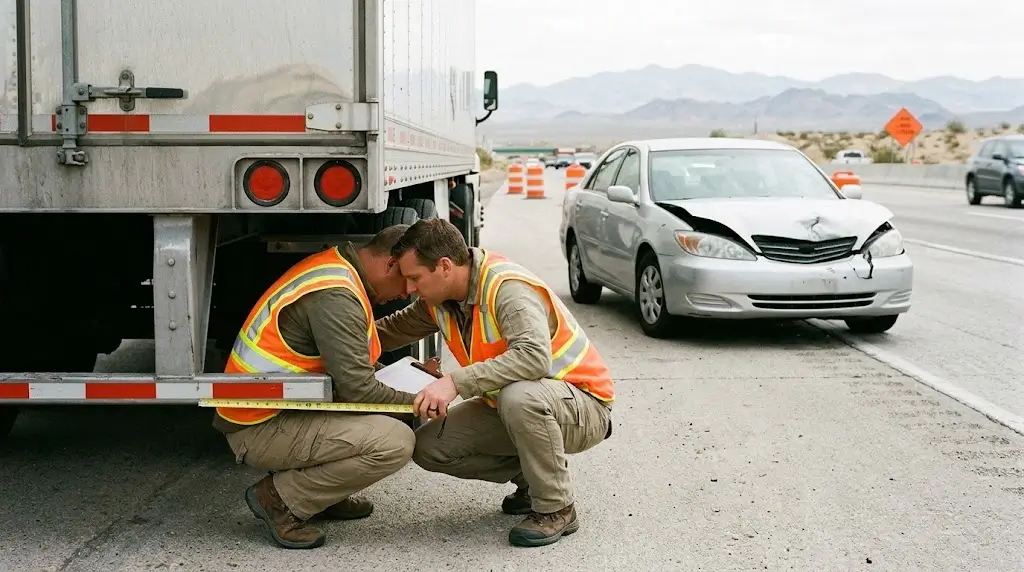
The trailer itself can become a central piece of evidence. Towing, repairs, or equipment replacement may change its condition, so investigators may need to document it promptly.
Useful evidence may include:
- Photographs of both vehicles, the impact point, the guard, its mounting brackets, welds, and damage to the passenger compartment.
- Trailer identification, inspection reports, maintenance records, repair invoices, and records of guard replacement or modification.
- Available vehicle data, telematics, dashcam footage, traffic camera video, and witness statements.
- Driver duty status records and dispatch messages when fatigue or scheduling may matter.
- Medical records, wage information, and other documents that establish the injuries and related losses.
Electronic records can be especially important. FMCSA generally requires carriers to retain electronic logging device records of duty status and supporting documents for six months. Other records may follow different retention periods. See FMCSA’s retention guidance. Put simply, investigators need to test what the evidence shows. An engineer or crash reconstruction expert may examine the guard, its attachments, the impact overlap, and the damage pattern. That analysis can help determine whether equipment performance contributed to the injuries.
Why the I-10 Crash Location Matters
The exact crash location may help investigators identify relevant lanes, interchanges, signs, traffic controls, and available video. These details can matter near construction or a changing roadway layout.
ADOT reported active construction on an 11-mile stretch of I-10 between Loop 202 and the Gila River on October 5, 2026. The work forms part of the I-10 Wild Horse Pass Corridor Project between Phoenix and Casa Grande. Planned improvements include added lanes, rebuilt interchanges, freeway cameras, and message boards. ADOT’s project update provides current details.
Construction alone does not establish that a road condition caused a crash. Investigators must examine the actual location, date, traffic setup, and available evidence before reaching that conclusion.
Arizona Deadlines and Potential Compensation
Arizona generally allows two years to file a covered personal injury lawsuit after the claim accrues. See A.R.S. § 12-542. Product liability claims may involve additional rules under A.R.S. § 12-551. Claims involving public entities may carry shorter notice and filing deadlines.
Depending on the evidence, damages may include medical expenses, future care, lost income, reduced earning capacity, pain, and lasting disability. A fatal crash may raise wrongful death issues. The applicable deadline and potential damages depend on the claim, the defendants, and the facts.
Frequently Asked Questions
Are underride guards effective in every collision?
No. Their performance depends on design, condition, attachments, impact location, overlap, and crash conditions. Neither a guard’s presence nor its failure settles liability by itself.
If a car strikes a truck, is the car driver automatically at fault?
No. Investigators must assess the circumstances and evidence. Arizona’s comparative fault rules may affect damages when an injured person shares responsibility.
What evidence matters after an underride crash?
The trailer, guard, mounting points, photographs, maintenance records, available electronic data, video, witness accounts, and expert analysis may all help establish what happened.
Talk With Harris Injury Law About an I-10 Underride Crash
An underride claim may require close examination of the trailer, guard, available records, and collision circumstances. Preserving relevant evidence early can help investigators determine what happened and who may be responsible.
Harris Injury Law, PLLC 1136 E Campbell Ave, Phoenix, AZ 85014 (480) 800-4878
If you or a family member suffered injuries in an underride crash, contact Harris Injury Law to discuss your options. A Phoenix truck accident lawyer can explain potential next steps and the evidence that may need preservation. People comparing Phoenix truck accident attorneys should ask how the firm handles evidence and explains deadlines. Those searching for a truck accident attorney Phoenix also need clear answers about liability and their options. You can request a free consultation.
This article provides general information about Arizona law, not legal advice and reviewed by Jason A. Harris, Attorney, Harris Injury Law, PLLC.