Skip to content

Maricopa County had confirmed 337 heat-related deaths in 2026 as of the week ending Oct. 10, about 80% more than the 187 confirmed at a comparable point in 2025, according to a Harris Injury Law analysis of county public health data. Another 445 deaths were still under investigation.
The rise follows two straight years of decline. It also comes as the Industrial Commission of Arizona is set to revisit workplace heat safety in December, when it could begin rulemaking for a statewide standard, according to KJZZ.
Key Findings
- Maricopa County confirmed 337 heat-related deaths in 2026 as of the week ending Oct. 10, 2026: 190 heat-caused and 147 heat-contributed.
- That is about 80% more than the 187 deaths confirmed at a comparable point in 2025.
- Another 445 deaths were under investigation. If 93 of them are confirmed, 2026 will pass 2025’s final total of 430 and end two straight years of decline.
- The National Weather Service in Phoenix issued heat warnings on 47 days in 2026 through Oct. 13, more than double the to-date average of 22 days.
- About three in four heat-related illness hospital visits in Maricopa County were adults aged 18 to 64, in each of 2024, 2025 and 2026.
- Of 102 indoor heat deaths in Maricopa County in 2026, 91 had air conditioning present. In 67 of them, the unit was not working.
- People experiencing homelessness made up 45% of Maricopa County’s confirmed heat deaths in 2026 so far.
- No public agency reports how many Arizona heat deaths happen at work. The county does not record it, and federal data for Arizona does not separate heat from other exposure deaths.
- As of Sept. 30, 2026, Arizona’s administrative code had no heat-specific workplace rule. Worker heat protections run through an Arizona Division of Occupational Safety and Health (ADOSH) emphasis program.
How many people have died from heat in Maricopa County in 2026?
Maricopa County had confirmed 337 heat-related deaths in 2026 as of the week ending Oct. 10. That is about 80% more than the 187 confirmed at a comparable point in 2025.
| Measure | 2026, week ending Oct. 10 | 2025, comparable point |
| Confirmed heat-related deaths | 337 | 187 |
| Deaths under investigation | 445 | 334 |
Of the 337 confirmed deaths, 190 were heat-caused, meaning heat exposure was listed as a direct cause on the death certificate. The other 147 were heat-contributed, meaning heat was listed as a contributing factor.
These counts will keep changing. The county says the Office of the Medical Examiner typically takes two to three months to finish a death investigation and confirm whether heat was involved. The county’s dashboard updates weekly on Tuesdays during the heat season.
Will 2026 end two years of decline?
It is close. Confirming 93 of the 445 deaths under investigation would put 2026 past 2025’s final total of 430.
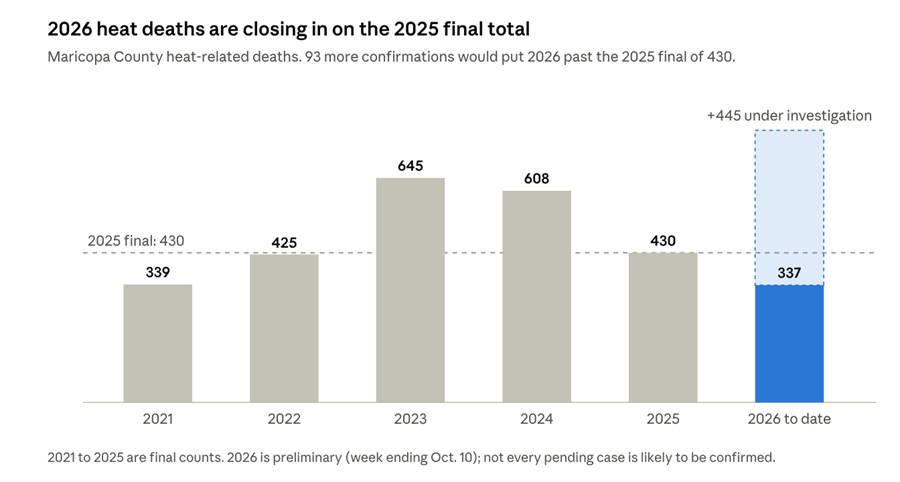
Maricopa County Department of Public Health: 2025 Heat-Related Deaths Report (2021 to 2025 final counts) and heat deaths dashboard (2026, week ending Oct. 10, 2026)
Matching the 2023 total of 645 would take 308 confirmations. The county calls the under-investigation figure the maximum possible number and says it is unlikely that every case will be confirmed.
How unusual was the 2026 heat season?
The National Weather Service in Phoenix issued heat warnings on 47 days in 2026 through Oct. 13. The to-date average for that point in the year is 22 days, and all of 2025 had 31.
| Measure | 2026, through Oct. 13 | 2025, full year |
| Heat warning days | 47 | 31 |
| Warning events | 7 | 5 |
| Longest event | 18 days (July 23 to Aug. 9) | 13 days |
| First warning | March 19 | June 14 |
| Last warning | Sept. 10 | Aug. 24 |
The first 2026 warning, on March 19, was the earliest start on record. The weather service counts a warning day when a warning is in effect at 3 p.m. local time.
Warning days show how early and how long the heat ran this year. On their own, they do not explain any individual death.
Who is getting sick from the heat?
About three in four heat-related illness hospital visits in Maricopa County were adults aged 18 to 64, in each of the last three years.
| Year | Visits, ages 18 to 64 | Visits, ages 65 and older | Visits, men |
| 2026, through Oct. 10 | 76% | 21% | 70% |
| 2025 | 78% | 20% | 68% |
| 2024 | 76% | 19% | 71% |
The visit data cover emergency department and inpatient visits at hospitals that report to the CDC’s National Syndromic Surveillance Program (BioSense). The 18-to-64 shares add up the county’s rounded age bands, so they are approximate.
Deaths follow a different pattern. Among 2026 heat deaths so far, 75% were men, 59% involved substances and 45% were among people experiencing homelessness. The largest age group was 50 to 64, at 26% of deaths.
The county’s data do not record a person’s job. They cannot show how many of these visits or deaths involved someone who was working at the time. They do show that most people treated for heat illness are of working age.
Where are heat deaths happening?
Most heat deaths happen outdoors. In 2026 so far, 69% of Maricopa County’s heat deaths occurred outdoors and 31% indoors, compared with a final split of 74% and 26% in 2025.
Indoor deaths often involve cooling that was not running. Of 102 indoor heat deaths in 2026, 91 had air conditioning present. In 67 of those the unit was not working, and in 19 it was turned off.
The county’s 2025 final report gives the latest full-year figures by the city where the injury occurred.
| City of injury | Heat-related deaths, 2025 |
| Phoenix | 233 |
| Mesa | 39 |
| Tempe | 18 |
| Glendale | 14 |
| Scottsdale | 9 |
| Peoria | 8 |
| Surprise | 6 |
| Chandler | 5 |
| Unincorporated Maricopa County | 42 |
The county does not list cities with fewer than five deaths, and 36 deaths in 2025 had an unknown city of injury. Counts reflect where the injury happened, not where the person lived. For 2026, the county’s dashboard maps deaths by ZIP code.
Who is most at risk?
This year brought more heat warning days than usual, a season that started earlier than ever and a death count on pace to end two years of decline. The data points to two groups that need attention first. One is counted closely. The other is barely counted at all.
People experiencing homelessness: They made up 45% of Maricopa County’s confirmed heat deaths in 2026 so far, and 208 of 430 in 2025, nearly half. Most heat deaths happen outdoors, and people without stable shelter have the fewest ways to get out of the heat.
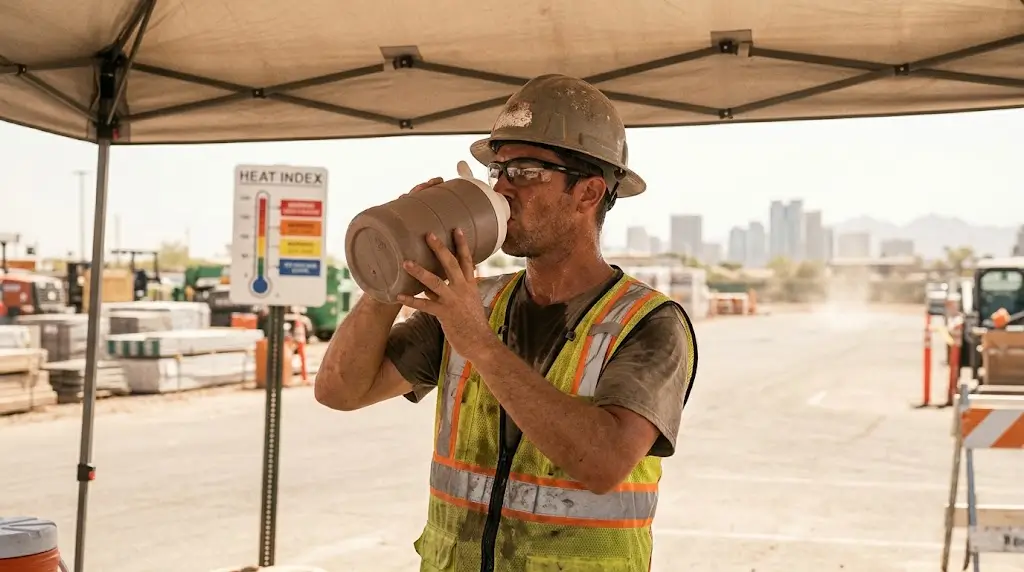
People who work in the heat: ADOSH’s heat program targets industries where heat illness is common, including construction trades, landscaping, crop and livestock work, couriers and local delivery, warehousing and waste collection. Yet no public agency reports how many Arizona heat deaths happen on the job:
- The county’s heat dashboard and annual report do not record whether a person was working when they were exposed to heat.
- The U.S. Bureau of Labor Statistics reported 19 Arizona work deaths in 2024 from exposure to harmful substances or environments, but does not publish heat deaths separately for the state.
- ADOSH’s own heat directive notes that a worker’s cause of death is often recorded as a heart attack when the actual or aggravating cause may have been heat.
- A KJZZ investigation in April 2026 found dozens of Arizona worker heat deaths in federal, state and county records going back decades, but reported that the true number is unclear. KJZZ noted that OSHA considers heat-related deaths and injuries vastly underreported.
The closest measure available is the hospital data above: about three in four people treated for heat illness are of working age. Without a count of deaths at work, it is hard to tell whether the protections described below are working. Counting comes first.
What is already being done?
Arizona’s workplace heat protections run through an ADOSH State Emphasis Program, not a stand-alone heat standard. The current version took effect April 9, 2026, replacing a version issued in July 2023.
Under the program, ADOSH:
- Schedules heat inspections in targeted industries on days the National Weather Service issues a local heat warning or advisory. Targeted industries include construction, landscaping, couriers and local delivery, warehousing and waste collection.
- Gives heat-related fatalities, complaints and referrals priority for inspection.
- Checks employers against the final recommendations of Arizona’s Workplace Heat Safety Task Force: a written heat illness prevention plan, cool drinking water (at least one quart per employee per hour where water is not plumbed or continuously supplied), shade, rest breaks without penalty, an acclimatization plan and training.
- Reviews the program within 12 months of its issue date.
The Industrial Commission of Arizona voted 5 to 0 on April 9, 2026, to adopt the task force recommendations. In the meeting minutes, commissioners described the move as an initial step on heat safety.
Heat citations under the program are issued under Arizona’s general employer’s duty law, A.R.S. § 23-403(A). It requires every employer to provide a workplace free from recognized hazards that are causing or are likely to cause death or serious physical harm. Subsection (C) of the same law states that a condition or practice common within an industry is not deemed a recognized hazard unless a standard or regulation concerning it has been developed.
As of Sept. 30, 2026, the Industrial Commission’s chapter of the Arizona Administrative Code contained no heat-specific workplace rule.
In April, the commission adopted the guidelines but did not open rulemaking for an enforceable standard, KJZZ reported. The chairman said rulemaking often takes more than a year and that the commission wanted more data on costs and impacts first. In July, KJZZ reported that the commission is set to discuss heat safety again in December and could begin rulemaking then.
For the public at large, Maricopa County’s Heat Relief Network ran from May 1 to Sept. 30, 2026, with more than 200 locations on its map. This year’s first heat warning came on March 19, six weeks before the network opened, and four warning days fell before May 1. By early October, the county’s 24/7 cooling centers had closed for the season while hundreds of possible heat deaths were still under investigation, AZFamily reported.
What Arizona should do next
The numbers point to a few practical steps. Most of them start with better records.
- Count heat deaths at work. The county could record whether each heat death happened while the person was working. The Industrial Commission could publish yearly counts of heat-related workers’ compensation claims, and ADOSH could report how many heat-related deaths it investigates. Together these would show, for the first time, how many Arizonans die from heat on the job.
- Bring that count to the December review. The Industrial Commission’s December discussion is the next chance to decide whether the April guidelines should become an enforceable standard. Data on worker deaths and claims would show whether the guidelines are working.
- Match relief to the real heat season. The warning season began March 19, before the relief network opened, and possible heat deaths were still under review after cooling centers closed. Tying relief to weather service warnings, not fixed calendar dates, would close that gap.
- Focus outreach on unhoused residents. They account for nearly half of heat deaths. Any expansion of cooling and outreach can be measured against that share.
- Help with broken cooling. In 67 of 2026’s 102 indoor heat deaths, an air conditioner was present but not working. Faster repair help, especially for older residents, would reach the people most at risk indoors.
If you are hurt by heat at work
Heat illness on the job can qualify for workers’ compensation, Arizona’s system that pays medical costs and lost-wage benefits to employees injured by accident arising out of and in the course of their work (A.R.S. § 23-1021). A claim generally must be filed with the Industrial Commission within one year of when the injury becomes manifest (A.R.S. § 23-1061). If someone outside the employer, such as another company on the job site, caused the injury through negligence, the worker may also bring a separate third-party claim, and the workers’ compensation carrier holds a lien on that recovery (A.R.S. § 23-1023). Our guide to personal injury vs. workers’ compensation explains how the two claims fit together. Workers and families with questions can request a free consultation with Harris Injury Law.
Methodology
- 2026 figures come from the Maricopa County Department of Public Health heat-related deaths dashboard for the week ending Oct. 10, 2026, and are preliminary. The 2025 comparison is the dashboard’s own prior-year figure (week range shown as 09/27 to 10/03); 2025 final totals and city counts come from the county’s 2025 annual report.
- Heat-illness visit shares add the dashboard’s rounded age bands for 2024, 2025 and 2026. Heat warning days come from the National Weather Service in Phoenix, which counts a day when a warning is in effect at 3 p.m.
- Rules and statutes were checked on Oct. 13, 2026, against ADOSH directive CPL 03-00-024, the Arizona Administrative Code (Supp. 26-3, rules filed through Sept. 30, 2026) and the Arizona Revised Statutes.
Sources
- Maricopa County Department of Public Health – Heat-related deaths and hospital visits dashboard, week ending Oct. 10, 2026 https://app.powerbigov.us/view?r=eyJrIjoiZWMwZTc3OWYtNDU1Zi00OTBlLWI0N2UtMGQyN2VkYTA5NzgwIiwidCI6IjMwY2QzNWQ0LTk5NTEtNGE3Mi05NzhlLTg5NjU1MDc1YzE3ZiJ9
- Maricopa County – Heat surveillance reports and data definitions https://www.maricopa.gov/1858/Heat-Surveillance
- Maricopa County – 2025 Heat-Related Deaths Report, April 2026 https://www.maricopa.gov/ArchiveCenter/ViewFile/Item/6510
- National Weather Service Phoenix – Heat warning days, 2025 and 2026 https://www.weather.gov/psr/heat
- Arizona Division of Occupational Safety and Health – Directive CPL 03-00-024, State Emphasis Program for heat-related hazards, effective April 9, 2026 https://www.azica.gov/sites/default/files/2026-04/Arizona%20Heat%20SEP%20CPL_03-00-024%20%204-9-26.pdf
- Industrial Commission of Arizona – Commission meeting minutes, April 9, 2026 https://www.azica.gov/agency-information/meetings
- Arizona Secretary of State – Arizona Administrative Code, Title 20, Chapter 5, Supp. 26-3 https://apps.azsos.gov/public_services/Title_20/20-05.pdf
- KJZZ – Commission adopts heat guidelines, defers rulemaking, April 10, 2026 https://www.kjzz.org/politics/2026-04-10/arizona-will-strengthen-workplace-heat-guidelines-but-wont-create-enforceable-standard-for-now
- KJZZ – Commission set to revisit heat safety in December, July 31, 2026 https://www.kjzz.org/text/politics/2026-07-31/arizona-has-new-workplace-heat-safety-guidelines-this-summer-some-still-want-more-enforcement
- KJZZ – Arizona workers die from heat exposure every year, April 6, 2026 https://www.kjzz.org/business/2026-04-06/arizona-workers-die-from-heat-exposure-every-year-here-are-a-few-of-their-stories
- U.S. Bureau of Labor Statistics – Fatal Work Injuries in Arizona, 2024 https://www.bls.gov/regions/west/news-release/fatalworkinjuries_arizona.htm
- Maricopa County – Heat Relief Network season announcement, April 30, 2026 https://www.maricopa.gov/CivicAlerts.aspx?AID=3652
- AZFamily – 275 heat deaths confirmed in Maricopa County, Oct. 2, 2026 https://www.azfamily.com/video/2026/10/03/275-heat-deaths-confirmed-maricopa-county-whats-driving-it/
- Arizona Legislature – A.R.S. § 23-403, Employer’s duty https://www.azleg.gov/ars/23/00403.htm
- Arizona Legislature – A.R.S. § 23-1021, Right of employee to compensation https://www.azleg.gov/ars/23/01021.htm
- Arizona Legislature – A.R.S. § 23-1023, Liability of third person; election of remedies https://www.azleg.gov/ars/23/01023.htm
- Arizona Legislature – A.R.S. § 23-1061, Notice of accident; claim for compensation https://www.azleg.gov/ars/23/01061.htm
Media note
Journalists may use these figures with a link to this page; This article is for general informational purposes only and is not legal advice. Reading it does not create an attorney-client relationship.