Skip to content

Tempe is ringed by freeways on all four sides, the Loop 202 Red Mountain along the north edge by Tempe Town Lake, US-60 Superstition across the south, the Loop 101 Price to the east, and I-10 to the west. Almost every commute in or out of the city touches one of them at the worst possible hour.
Chain-reaction crashes on those corridors behave nothing like a two-car collision at a traffic light. Fault is divided rather than assigned, several insurers end up involved, and the single most dangerous moment often comes after the first impact.
Should You Move Your Car, or Leave It Where It Stopped?
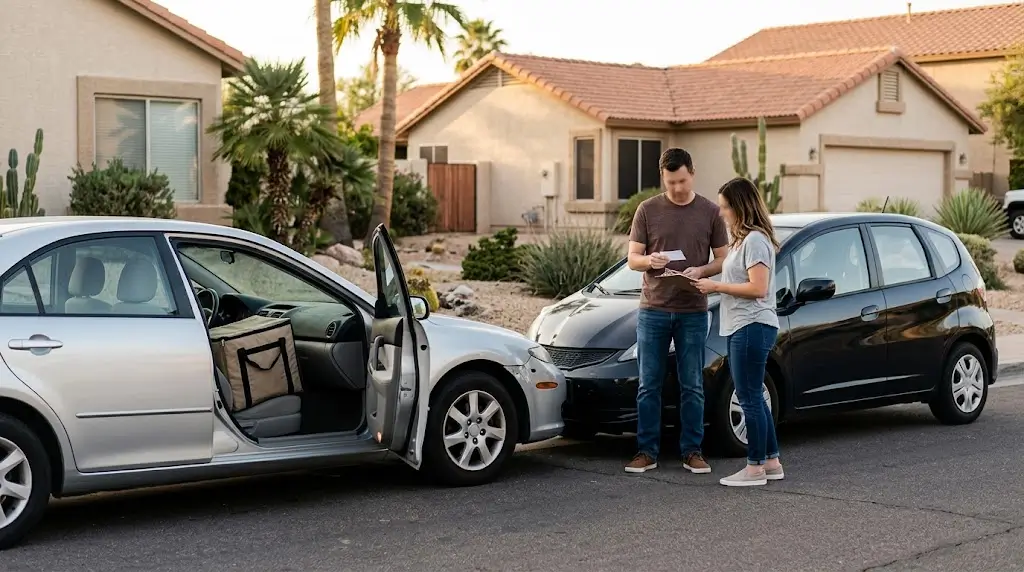
Move it if you safely can and Arizona protects you for doing so. This is the question people get wrong under pressure, usually because they believe moving the vehicle destroys evidence or concedes something.
A.R.S. § 28-674 provides that where serious physical injury or death is not apparent, the drivers or any occupant holding a valid license shall remove the vehicles from the main traveled portion of the roadway to the shoulder, emergency lane or median, provided the vehicle can be driven safely under its own power and the move can be made safely.
Then the provision that matters most:
A person who removes a motor vehicle from the main traveled portion of the roadway before the arrival of a police officer is not liable or at fault regarding the cause of the traffic accident solely by reason of moving the motor vehicle.
So clearing the lane cannot be used against you. Photograph the final rest positions first if there is time and it is safe but on a live freeway at rush hour, getting out of the travel lanes comes first.
The Second Crash Is Often the Worse One
Approaching traffic has a statutory duty toward you, and most drivers do not know it applies. Once you are stopped with hazards on, Arizona’s Move Over Law at A.R.S. § 28-775 is engaged.
The scope is broader than almost anyone realizes. The Arizona Department of Public Safety and the state’s own campaign put it as “every vehicle, every time” the law applies to any vehicle displaying flashing or warning lights at the side of the road, not only police and ambulances. A disabled passenger car with its hazards on counts.
On a freeway with at least two lanes in the same direction, an approaching driver must change into a lane not adjacent to the stopped vehicle. Where that is impossible or unsafe, they must reduce speed and proceed with due caution.
A driver who plows into a stopped pileup has a statutory violation attached to them, and that matters because secondary impacts are frequently the ones that cause catastrophic injury. If you were struck a second time while stationary, that is a separate liability question from the original chain reaction.
Who Investigates a Loop 202 Crash?
DPS, not Tempe Police. Collisions on the Loop 202, US-60, Loop 101 and I-10 are typically worked by the Arizona Department of Public Safety, while Tempe PD handles city surface streets.
A report request sent to the wrong agency returns nothing, and in a multi-vehicle crash the report is usually what establishes the sequence. Read it closely when it arrives: a reversed direction of travel, a misidentified vehicle, or an omitted witness is far easier to correct in week one than in month six.
Why Winning Does Not Always Mean Being Paid
Two Arizona rules decide what a pileup is actually worth.
Each defendant pays only its own share. A.R.S. § 12-2506 abolished joint and several liability, so if a jury assigns three drivers 50%, 30% and 20%, you collect those shares separately. You cannot collect the whole award from whichever driver has the best policy. Our companion piece on how fault is determined in multi-car pileups works through the arithmetic.
The per-accident limit is a shared pot. A.R.S. § 28-4009 sets Arizona’s minimums at $25,000 per person and $50,000 per accident. If five people are injured by one minimally insured driver, they are competing for $50,000 in total, not $25,000 each. On a rush-hour freeway, that happens routinely.
Together these make your own underinsured and uninsured motorist coverage the practical source of recovery in most serious pileups. Insurers must offer it under A.R.S. § 20-259.01, though buying it is optional so your declarations page matters more here than almost anywhere. A car crash attorney in Tempe will usually check it before anything else.
Fault Gets Divided, and the Phantom Gets Blamed
Arizona applies pure comparative negligence under A.R.S. § 12-2505, so an award drops by your assigned share of the fault with no cutoff barring recovery.
Expect two arguments. The first is following distance A.R.S. § 28-730 requires not following more closely than is reasonable and prudent, with due regard for speed, traffic and highway conditions. There is no fixed car-length or second-count rule, which means a middle vehicle struck from behind and pushed into the car ahead may bear little fault for the forward impact. That is a sequencing question, not a position question.
The second is the vehicle that caused it and left. Under Rule 26(b)(5) of the Arizona Rules of Civil Procedure, a defendant may designate a nonparty at fault a driver who fled or was never identified and ask a jury to allocate blame there. Fault assigned to an empty chair is a fault nobody pays. The designation generally must be made within 150 days of filing an answer.
Dust, Glare and the Posted Speed
The sign is not a safe harbor on these corridors. A.R.S. § 28-701 requires a speed that is reasonable and prudent given actual and potential hazards, and subsection D reduces the maximum where weather or highway conditions create a special hazard.
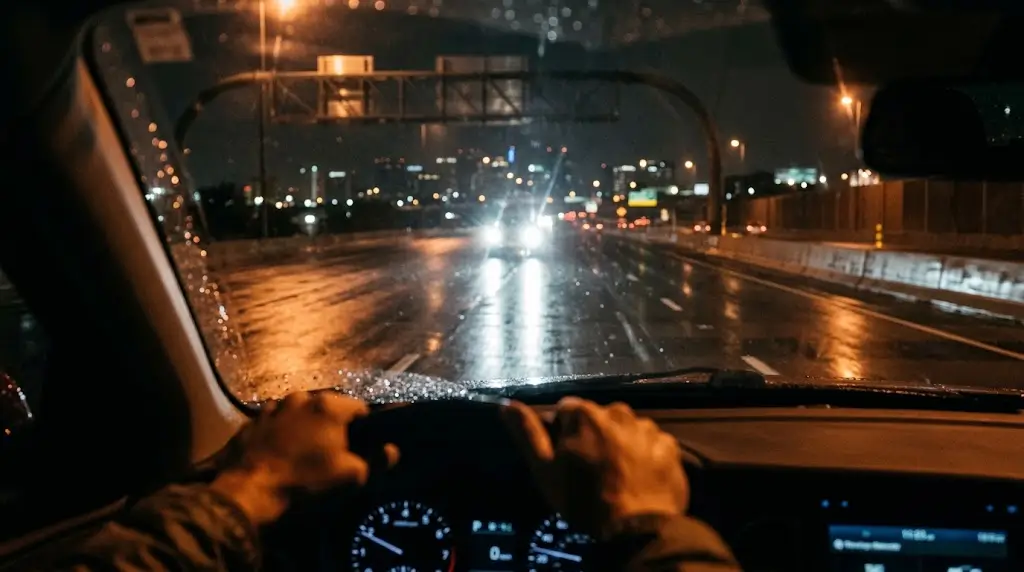
Two Tempe-specific conditions trigger it. Monsoon cells and blowing dust can drop freeway visibility in seconds. And because the Loop 202 Red Mountain runs broadly east-west through Tempe, low sun at commute hours produces genuine glare blindness at predictable times morning eastbound, evening westbound. A driver traveling at the posted limit into either can be violating the speed statute, and the contested issue becomes whether the onset was sudden or whether there was time to adapt.
Time-stamped photographs and dashcam footage settle that question in a way recollection eight months later cannot.
What If the Road or a Work Zone Contributed?
Then the defendant is probably the State, not the City and the clock is 180 days. Freeways through Tempe are state highways, so where signage, lane configuration, a construction zone or a roadway condition contributed, the responsible entity is generally the Arizona Department of Transportation rather than the City of Tempe.
That matters because A.R.S. § 12-821.01 requires a notice of claim against a public entity to be served within 180 days of accrual, on the official authorized to accept service, stating a specific settlement amount with supporting facts followed by one year to file suit rather than two.
Where a private contractor’s traffic control contributed instead, that is an ordinary defendant on the two-year schedule. Identifying which applies is a threshold question, not a detail.
Deadlines
Generally two years under A.R.S. § 12-542, running from the date of injury or, in a wrongful death action, the date of death. Claims for injured minors are generally tolled until eighteen under A.R.S. § 12-502, and the public entity track above is the significant exception. Negotiations pause none of it, so the deadlines that apply to your claim are worth confirming in the first week.
Freeway-speed collisions run toward traumatic brain injury claims, and commercial vehicles in the mix bring truck and distracted driving issues of their own.
Frequently Asked Questions
Should I move my car after a crash on Loop 202? Yes, if it can be driven safely and no serious injury or death is apparent. A.R.S. § 28-674 requires drivers to clear the main traveled portion of the roadway in those circumstances, and expressly provides that moving the vehicle before police arrive does not make you liable or at fault for causing the accident.
Who investigates a crash on the Loop 202 or US-60 in Tempe? The Arizona Department of Public Safety typically works freeway collisions, while Tempe Police handles city surface streets. Each keeps separate records, so a report request sent to the wrong agency returns nothing.
If several drivers were at fault, can I collect everything from one of them? No. A.R.S. § 12-2506 abolished joint and several liability in Arizona, so each defendant is generally responsible only for its own percentage. A driver who is uninsured, or fault allocated to an unidentified nonparty, represents a share that goes unpaid.
I was hit a second time while stopped. Is that a separate claim? It can be. Arizona’s Move Over Law at A.R.S. § 28-775 requires approaching drivers to change lanes away from any vehicle displaying flashing or warning lights, or to slow down where a lane change is unsafe. A driver who strikes a stopped vehicle has a statutory violation attached to them, separate from the original chain reaction.
Can I be at fault for driving the speed limit in dust or glare? Yes. A.R.S. § 28-701 requires a speed that is reasonable and prudent given actual and potential hazards, and subsection D reduces the maximum where weather or highway conditions create a special hazard. Traveling at the posted limit into near-zero visibility can violate the speed statute.
What if the construction zone caused the pileup? It depends who was responsible. Freeways through Tempe are state highways, so a claim based on signage, lane configuration or roadway condition generally runs against the Arizona Department of Transportation requiring a notice of claim within 180 days under A.R.S. § 12-821.01. A private contractor is an ordinary defendant on the two-year schedule.
Talk to a Tempe Car Accident Lawyer
A pileup produces several claims, several insurers, and a fault distribution that is negotiated rather than obvious. The parties who move first on reconstruction and preservation tend to shape it.
If you were caught in one, a tempe car accident lawyer can establish the sequence and identify every policy in reach before the other carriers settle the narrative between themselves.
Harris Injury Law, PLLC 1136 E Campbell Ave, Phoenix, AZ 85014 (480) 800-4878
Consultations with a Tempe car accident attorney are free, and cases run on a contingency fee no attorney fee unless compensation is recovered. Request a consultation, meet our attorneys, or read more about our Tempe personal injury practice. Every case depends on its own facts; no outcome can be promised or predicted.
This article provides general information about Arizona law and is not legal advice. Reading it creates no attorney-client relationship. Arizona statutes and court rules change. Consult a licensed Arizona attorney about your situation.
Reviewed by Jason A. Harris, Harris Injury Law, PLLC.