Skip to content

A crash near Price Road or Loop 202 can leave you with injuries, car repairs, missed work, and insurance questions. The exact location and collision sequence can affect which evidence matters. A freeway ramp crash may raise different questions from a surface street collision. This guide covers evidence, Arizona fault rules, insurance, and deadlines. Consult with a Chandler car accident lawyer about your crash to discuss the options you have.
Why the Exact Location Matters Around Chandler’s Price Corridor
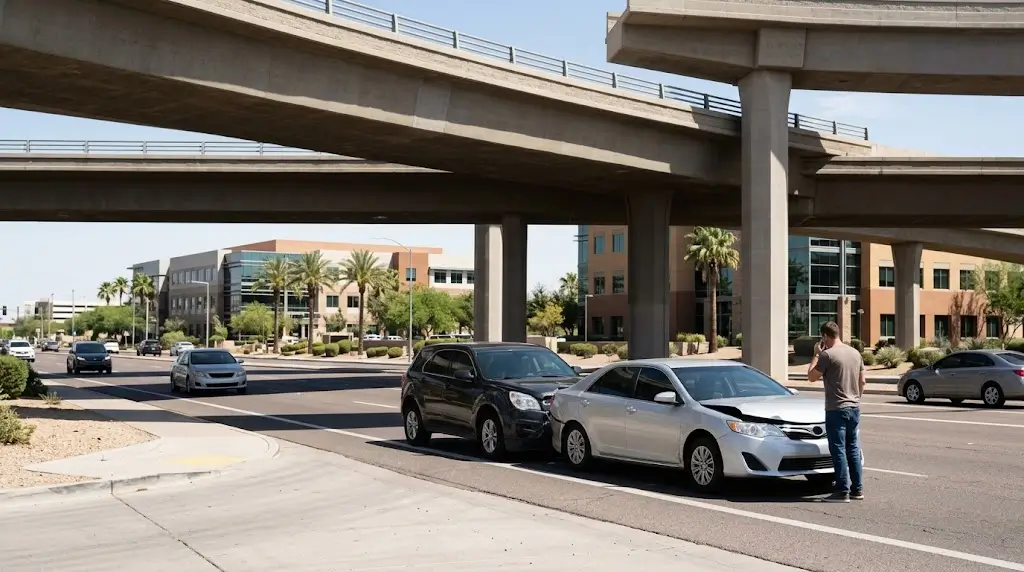
Chandler describes the Price Corridor as a high-technology employment center near the Loop 101 and Loop 202 interchange. The area includes corporate campuses, offices, and mixed-use properties. Price Road is a surface street. Loop 101 is the Price Freeway. Loop 202 is the Santan Freeway. Keep these locations distinct when documenting a crash.
What Chandler’s Latest Crash Data Reveals About Price Road and Loop 202
Chandler’s latest roadway safety review provides important context for drivers traveling near Price Road and the Loop 202 Santan Freeway. However, citywide crash totals cannot establish how often crashes occur at one specific intersection. From 2021 through 2025, Chandler recorded more than 16,000 crashes. The city reports that 356 resulted in severe injuries and 74 involved one or more fatalities. These figures come from Chandler’s Roadway Safety Action Plan, a federally supported initiative launched in June 2026. The city expects to complete the plan in July 2027.
The initial safety screening identified 16 intersections and 29 roadways where crashes were concentrated. Price Road and Queen Creek Road appeared among the highlighted intersections. Pecos Road and Arizona Avenue also made the list. City officials have clarified that inclusion does not automatically mean a location has a road-safety defect. The screening helps engineers identify where further investigation may be needed. (ABC15’s report on Chandler’s study)
Recent incidents also show why the details of an individual collision matter. On October 5, 2026, three vehicles were involved in a fatal crash on westbound Loop 202 near Cooper Road. The Arizona Department of Public Safety reported that a pickup truck struck an SUV from behind, then rear-ended another vehicle. The pickup overturned, and one person later died at the hospital. Another person suffered non-life-threatening injuries. Investigators had not completed their investigation when Arizona’s Family reported the crash. The report does not establish that road design or construction caused the collision.
ADOT’s 2024 Arizona Motor Vehicle Crash Facts report provides another local reference point. Chandler recorded 4,267 crashes that year, including 14 fatal crashes. Those incidents resulted in 15 deaths and 1,856 injuries. These annual figures measure citywide crash activity, not crashes specifically on Price Road or Loop 202. (ADOT’s 2024 Crash Facts report)
Statewide figures offer broader context. ADOT reported 1,156 traffic deaths and 118,052 crashes across Arizona in 2025. Compared with 2024, fatalities fell by 5.2% and total crashes declined by 4.4%. Speeding contributed to crashes involving 367 fatalities, while alcohol impairment contributed to crashes involving 334 fatalities. These figures cover Arizona roads statewide and should not be treated as statistics for Chandler’s Price Road corridor. (ADOT’s 2025 crash data update) A Chandler car accident lawyer can review the available records and explain how Arizona law may apply to the circumstances.
What Should You Do After a Crash Near Price Road or Loop 202?
Protect yourself and seek medical help when needed. Call 911 for emergencies. Move to safety only when you can. Never enter active traffic to take photographs or retrieve item. Arizona law requires drivers involved in crashes that cause injury or death to stop and remain until they meet the applicable duties under A.R.S. § 28-661 and A.R.S. § 28-663. Section 28-663 addresses identifying information and reasonable assistance to injured people.
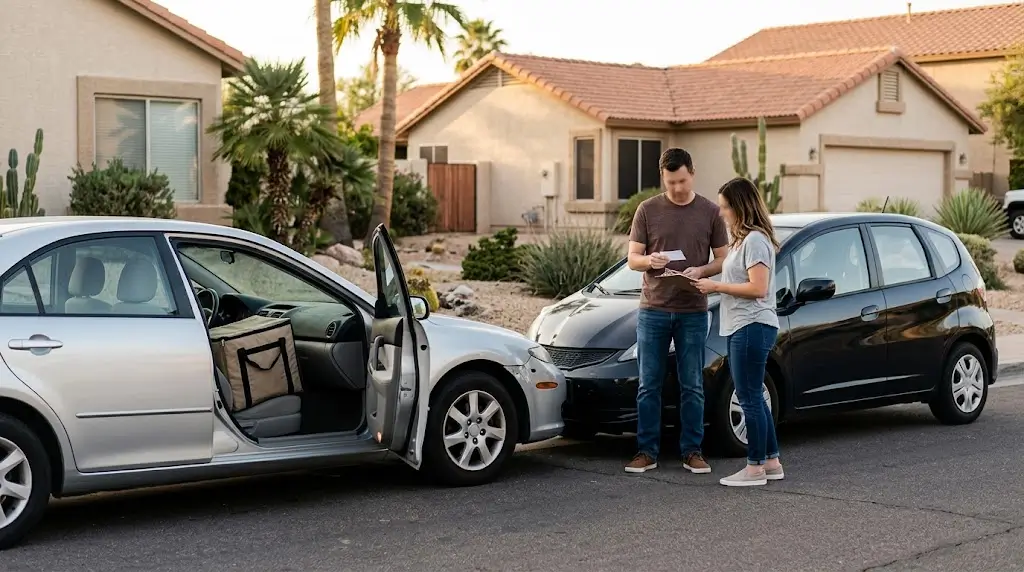
When safe, record the date, time, location, travel direction, and vehicles involved. Save witness contact details. Photograph damage, road markings, signs, debris, and vehicle positions from safety. Keep medical records, repair estimates, and insurer messages.
What Evidence Can Help Explain a Multi-Vehicle Crash?
In a multi-vehicle collision, the impact sequence can matter. Investigators may need evidence beyond the initial report to assess each driver’s actions.
Preserve these details when available:
- Scene evidence: Photographs of vehicle positions, damage, debris, lane markings, signs, and skid marks.
- Witness information: Names and contact details for people who saw the collision.
- Video: Dashcam recordings or relevant traffic or business footage, if a recording exists.
- Vehicle records: Repair estimates and vehicle data, when available and relevant.
- Injury and wage records: Treatment notes, bills, time missed from work, and wage documentation.
This evidence may help clarify a merge, rear end collision, braking, or disputed lane change. No single item necessarily resolves fault. Preserve original files because some recordings may not remain available. Write down your own sequence of events while your memory is fresh. Separate what you personally observed from what you assume happened. Do not guess at speeds or distances you did not measure. Keep unedited photos and video files. Someone searching “car crash attorney chandler” may first need a practical answer: which records could explain what happened? The answer depends on the crash and available evidence.
How Do You Get the Correct Arizona Crash Report?
Identify the investigating agency, keep the incident number, and follow its official records request process. Freeway and city street crashes may involve different agencies.
Under A.R.S. § 28-667, an officer or public employee who investigates a qualifying crash must complete a written report. The statute covers crashes involving bodily injury, death, property damage above the statutory threshold, or a citation. It sets a timeframe for completing the report after the investigation. That does not guarantee when the public can obtain a copy. The report documents the initial investigation but does not decide civil liability. Harris Injury Law also discusses records and deadline concerns in its guide to common Arizona injury claim mistakes.
How Does Arizona Decide Who Was at Fault?
Arizona follows a comparative fault rule. Under A.R.S. § 12-2505, a claimant’s damages generally decrease in proportion to the claimant’s fault that proximately caused the injury. Partial fault does not automatically bar recovery under the general rule, although legal exceptions apply.
Drivers may dispute a lane change, following distance, or vehicle movement before impact. Investigators can review damage, photographs, witnesses, video, and the crash report. A citation does not resolve every civil liability question. People searching for a “chandler car accident attorney” may need clear guidance on how this rule affects a claim. Read Harris Injury Law’s guide to Arizona comparative fault.
Which Insurance May Cover Your Losses?
The at-fault driver’s liability policy may cover qualifying injuries and property damage, subject to policy terms and limits. For many policies issued or renewed since July 1, 2020, Arizona’s minimums are $25,000 per injured person, $50,000 per crash for bodily injury, and $15,000 for property damage. See A.R.S. § 28-4009. Minimum limits may not cover every loss in a serious crash. Your own policy may offer uninsured or underinsured motorist coverage, depending on the coverage you selected and the circumstances. A.R.S. § 20-259.01 explains Arizona’s statutory framework for those coverages.
Keep policy documents, claim numbers, insurer letters, medical bills, and repair estimates. Arizona law treats uninsured and underinsured motorist coverage as distinct. The facts and policy terms determine whether either coverage applies. A claim investigation may also consider whether multiple policies cover different losses.
What If Roadwork or a Roadway Condition May Have Contributed?
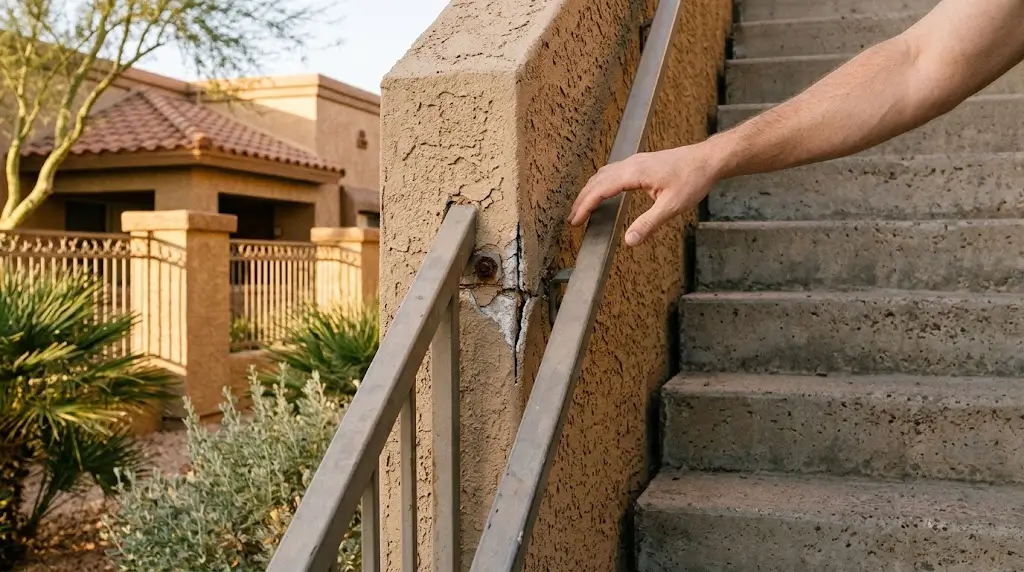
A lane closure, unclear marking, missing sign, or roadway defect may warrant investigation if evidence links it to the crash. Location alone does not establish negligence by a road owner or contractor. An investigation may seek traffic control plans, lane closure records, maintenance documents, or contractor logs. Availability and relevance depend on the location and issue.
A claim involving a public entity can have shorter deadlines than an ordinary injury claim. A.R.S. § 12-821.01 generally requires a notice of claim within 180 days after the cause of action accrues. A.R.S. § 12-821 generally requires an action against a public entity or employee within one year after accrual. Exceptions and accrual rules can affect a specific case. The October 5, 2026 crash reported near Cooper Road does not establish that construction caused the collision. Any such conclusion would require supporting evidence.
How Long Do You Have to File an Arizona Injury Claim?
Many Arizona personal injury actions have a two-year limitation period under A.R.S. § 12-542, subject to accrual rules and exceptions. Claims against public entities may involve the separate notice and filing rules discussed above. Do not assume an insurance claim or settlement discussion extends a court deadline. Confirm the rules that apply to your circumstances promptly. If you suspect a public entity may share responsibility, do not wait for an ordinary insurer response before checking the special notice rules.
Frequently Asked Questions
Can I recover damages if I was partly at fault?
Possibly. Arizona’s comparative fault law generally reduces damages according to the claimant’s share of fault rather than automatically barring recovery. The facts and applicable law matter.
Does a traffic violation automatically prove who caused a crash?
No. A suspected or documented violation may be relevant, but investigators must assess the evidence and how the law applies to the collision.
What if the other driver does not have enough insurance?
Review the available liability limits and check whether your own policy includes applicable underinsured motorist coverage. Policy language and the facts determine whether coverage applies.
Can road construction make ADOT or a contractor responsible?
Not by itself. Evidence must support a legal basis for liability, and special notice and filing deadlines may apply to public entity claims.
How do I obtain the crash report?
Identify the investigating agency, keep the report number, and follow the agency’s official records request procedure. Availability and release times can vary.
Talk With Harris Injury Law About Your Chandler Crash
Evidence, insurance, and filing deadlines can raise difficult questions after a collision. For information about Harris Injury Law’s Chandler services, visit our page for a Chandler car accident lawyer or contact page. Options depend on the facts, applicable law, and insurance terms. No outcome or payment is guaranteed.
This article provides general information, not legal advice for a specific case.
Reviewed by Jason A. Harris, Harris Injury Law.