Skip to content
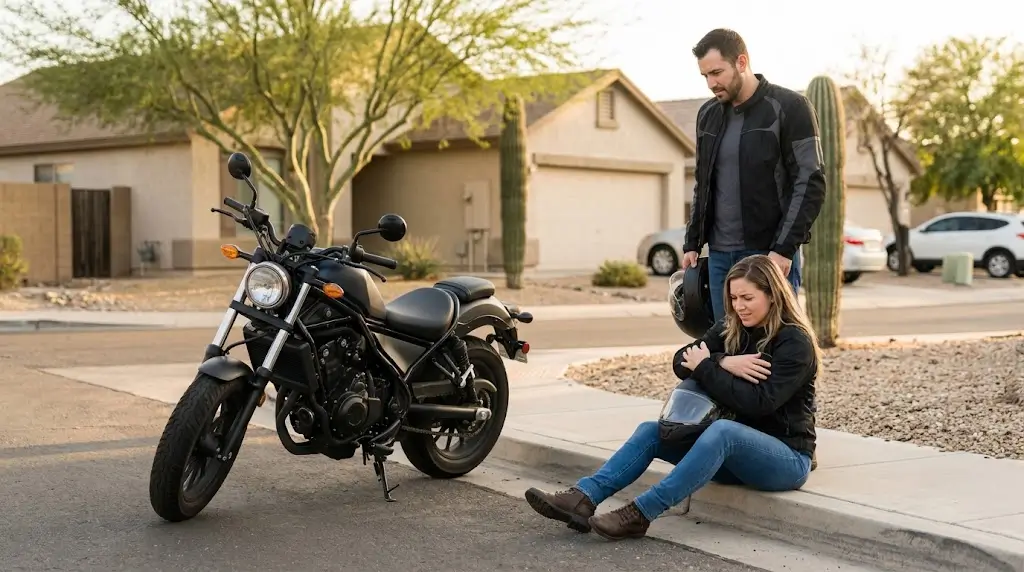
A motorcycle passenger has the cleanest liability position of anyone involved in a crash and, surprisingly often, the hardest coverage problem. You did not operate anything, so there is rarely a credible argument you caused it. But if the rider you were sitting behind lives in your household, their insurance may pay you a fraction of what they bought.
That second issue decides more passenger claims than fault ever does, and almost nobody mentions it.
Can a Motorcycle Passenger Sue the Driver?
Yes and you may be able to claim against two policies at once. A passenger injured in a crash can pursue the at-fault driver of another vehicle, the rider of the motorcycle, or both, depending on how fault is distributed.
That “or both” matters more than it sounds. Arizona abolished joint and several liability under A.R.S. § 12-2506, so each responsible party pays only its own percentage. If a jury assigns the car driver 70% and your rider 30%, you recover those shares separately and if your rider was never brought into the claim, that 30% is simply unpaid.
A motorcycle crash lawyer will usually pursue both from the outset for exactly that reason, not because anyone wants to blame the rider.
Are Passengers Ever Found at Fault?
Rarely, but it is not impossible. Arizona applies pure comparative negligence under A.R.S. § 12-2505, so any share of fault assigned to you reduces the award with no cutoff barring recovery.
For a passenger there is usually nothing to assign. You were not steering, braking, choosing a line, or judging a gap. The narrow exceptions insurers do raise:
- Interfering with the controls or the rider’s balance
- Knowingly riding with an impaired rider, where you were aware of the impairment before getting on
- Distracting the rider in a way that contributed to the crash
Each requires proof, and none is established by the fact that you chose to ride. Expect the argument in a serious claim, and expect it to be worth far less than an adjuster suggests.
The Coverage Problem Nobody Warns Passengers About
If you live with your rider, their policy may pay you only the state minimum. This is the single most important thing on this page.
Many Arizona auto policies contain what is known as a household, family, or intra-family exclusion. The Arizona Department of Insurance and Financial Institutions describes it plainly: Arizona law permits insurers to impose an exclusion limiting bodily injury liability coverage available to family members or residents of the same household injured through the negligence of another insured, cutting it to $25,000 per person and $50,000 per accident, regardless of how much liability coverage was actually purchased.
Think about what that means in practice. A rider carrying $250,000 in liability coverage takes their spouse, partner, adult child or housemate out for the afternoon, makes a mistake, and the passenger is badly hurt. The exclusion can reduce the available coverage to $25,000 a figure one surgery exhausts.
Three points to hold onto:
It cannot cut below the state minimum. Arizona requires that where a policy contains a household bodily-injury exclusion, it applies only to coverage exceeding the mandatory minimum limits. The floor stays.
It is not automatic. Not every policy contains one, the definitions of “family member” and “resident” vary between policies, and whether you actually fall inside the definition is a question worth examining rather than conceding.
It has been contested successfully. Arizona courts have applied the reasonable expectations doctrine to invalidate household exclusions in some circumstances, where what the policy actually did defeated what the purchaser reasonably understood they were buying.
This is the reason a motorcycle injury attorney asks early where you live and who you live with. It is not a personal question; it determines what the claim is worth.
Where Else Can Coverage Come From?
Usually from your own side, and from more places than people expect. Where the rider’s coverage is limited or exhausted, these layers matter:
- Your own uninsured and underinsured motorist coverage. It generally follows the person rather than the vehicle, so it can respond even though you were a passenger on someone else’s motorcycle and your own car was parked at home.
- A resident relative’s policy, which may extend to you as an insured.
- The motorcycle policy’s own UM coverage, where the at-fault party was another driver with no insurance.
- The at-fault driver’s liability policy, if a car was involved a separate and usually larger source than the motorcycle.
Insurers must offer UM and UIM under A.R.S. § 20-259.01, though buying it is optional, so check your declarations page and any you are named on. Our Phoenix uninsured motorist page covers how those claims run.
One further wrinkle worth asking about: some motorcycle policies treat passenger liability differently from the main liability coverage, so confirming that passengers are covered at all is a reasonable first question.
Was a Helmet Required for the Passenger?
Only if the passenger was under eighteen. A.R.S. § 28-964 requires a protective helmet for operators and passengers under the age of eighteen, and limits citations under that subsection to riders who are sixteen or seventeen and hold a license or permit. An adult passenger riding without one has violated no Arizona law.
A precision point in your favor: the statute’s eye protection requirement applies to the operator glasses, goggles or a transparent face shield unless the motorcycle has a windshield. It is not a passenger requirement, so an argument built on a passenger’s lack of eyewear has no statutory footing.
Insurers still raise helmet non-use as a severity argument. It cannot make the at-fault party less responsible for causing the crash, it reaches only damages attributable to head injury, and the party asserting it must prove with medical evidence that a helmet would have changed the outcome which is a different thing entirely from the rules Arizona riders actually have to follow.
What Are These Claims Worth, and How Long Do You Have?
A passenger is thrown without any of the limited protection a rider has from the machine, which is why these files run toward brain injury and spinal cord injury claims, and in fatal cases to wrongful death actions brought by statutory beneficiaries. Arizona’s constitution prohibits statutory caps on compensatory damages, so the ceiling is evidence and available coverage which brings the household exclusion back to the center of the analysis.
The filing deadline is generally two years from injury under A.R.S. § 12-542, with claims for injured minors tolled until age eighteen under A.R.S. § 12-502 relevant where a young passenger was hurt. Phoenix motorcycle accident attorneys will also want the rider’s declarations page early, since the coverage question shapes everything else.
Frequently Asked Questions
Can a motorcycle passenger sue the driver of the bike they were on? Yes. A passenger may bring a claim against the rider, the driver of another vehicle, or both. Because A.R.S. § 12-2506 abolished joint and several liability in Arizona, each responsible party pays only its own percentage of fault so a share assigned to a party who was never brought into the claim goes unpaid.
Can a motorcycle passenger be blamed for the crash? Rarely. A passenger is not steering, braking or judging gaps, so there is usually no credible basis to assign fault. The narrow exceptions insurers raise are interfering with the controls or the rider’s balance, distracting the rider, or knowingly riding with an impaired rider and each requires proof.
What if I live with the rider does that affect my claim? It can affect it substantially. Arizona permits insurers to include a household or intra-family exclusion limiting bodily injury liability coverage for family members or household residents to the state minimum of $25,000 per person, regardless of how much coverage was purchased. The exclusion cannot cut below the minimum, does not appear in every policy, and has been successfully contested in some circumstances.
Does a motorcycle passenger have to wear a helmet in Arizona? Only if under eighteen. A.R.S. § 28-964 requires helmets for operators and passengers under the age of eighteen. An adult passenger riding without one violates no state law, and the statute’s eye protection requirement applies to the operator rather than the passenger.
Can I claim on my own insurance if I was a passenger on someone else’s motorcycle? Often yes. Uninsured and underinsured motorist coverage generally follows the person rather than the vehicle, so your own policy or one you are named on as a resident relative may respond even though your car was parked at home. Insurers must offer it under A.R.S. § 20-259.01, though purchasing it is optional.
How long does a motorcycle passenger have to file a claim in Arizona? Generally two years from the date of injury under A.R.S. § 12-542. Claims for injured minors are typically tolled until age eighteen under A.R.S. § 12-502, and negotiating with an insurer pauses neither period.
Find Out What Coverage Actually Exists
Before anything else in a passenger claim, two documents matter: the rider’s declarations page and yours. Together they determine whether this is a claim worth six figures or one capped at the state minimum and that answer rarely matches what anyone assumed.
A Phoenix motorcycle accident attorney can review both before you give a recorded statement to anyone.
Harris Injury Law, PLLC 1136 E Campbell Ave, Phoenix, AZ 85014 (480) 800-4878
Consultations with a motorcycle accident attorney in Phoenix are free, and cases run on a contingency fee no attorney fee unless compensation is recovered. Request a consultation or meet our attorneys. Every case depends on its own facts; no outcome can be promised or predicted.
This article provides general information about Arizona law and is not legal advice. Reading it creates no attorney-client relationship. Insurance policy terms and Arizona law change, and coverage depends on the specific policy involved. Consult a licensed Arizona attorney about your situation.
Reviewed by Jason A. Harris, Harris Injury Law, PLLC.