Skip to content

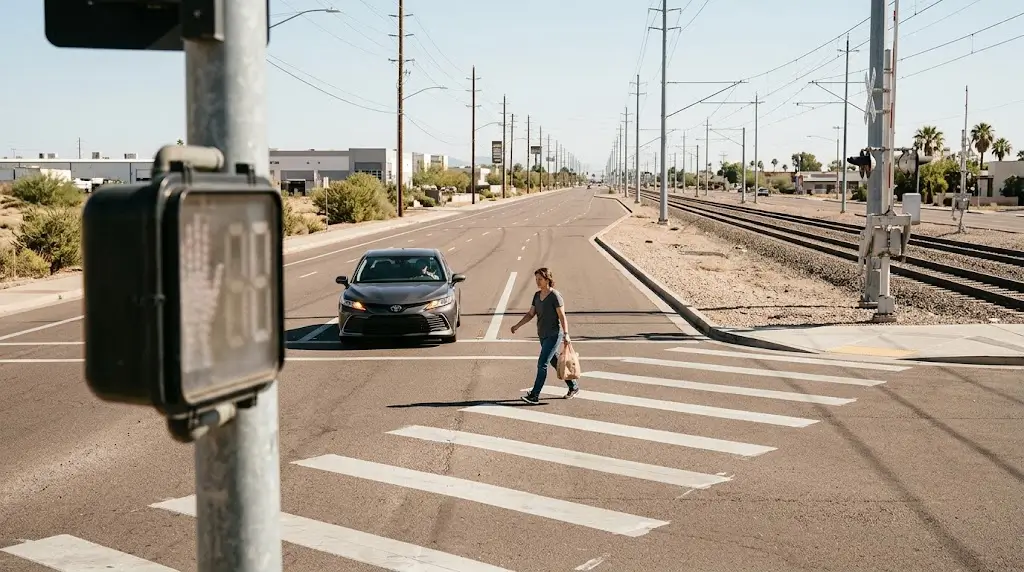
Grand Avenue is unlike any other road in Glendale. It cuts northwest across the city’s mile grid at an angle, carries US-60 traffic at highway speeds, and runs with a rail line alongside it for its entire length through town. Where it crosses an avenue and a street at the same point, the result is an offset, multi-leg intersection with crossing distances considerably longer than a square corner.
That geometry produces one scenario over and over: a pedestrian steps off legally, the countdown expires while they are still in the roadway, and the insurer calls it their fault.
Arizona statute says otherwise.
The Countdown Ran Out. Were You Still Allowed to Be There?
Yes, if you entered on the walk signal. A.R.S. § 28-646 sets out exactly what the signals mean, and the second half of the provision is the one nobody quotes:
A pedestrian shall not start to cross the roadway in the direction of the signal, but a pedestrian who has partially completed crossing on the walk signal shall proceed to a sidewalk or safety island while the don’t walk signal is showing.
Read that carefully. The upraised hand prohibits starting. For someone already in the roadway who began on the walk signal, the statute does not merely permit continuing; it directs them to proceed to the far side.
So an adjuster arguing that you were in the crosswalk against a don’t-walk signal has described conduct the statute expressly contemplates. The question that matters is not what the signal showed at impact. It is what the signal showed when you left the curb.
There is a counterpart in subsection B worth knowing: a pedestrian may not loiter or unduly delay crossing after traffic has stopped to give the right of way. Proceeding steadily is what the statute asks.
Why Grand Avenue Produces This Situation
Signal timing is calculated from crossing distance and an assumed walking speed. A diagonal crossing is longer than a perpendicular one across the same roadway that is simple geometry and Grand Avenue’s angled intersections add offset legs and multi-phase signals on top of it.
Three consequences follow for anyone on foot:
- The crossing takes longer than the countdown suggests, particularly for older pedestrians, anyone using a mobility aid, or someone carrying shopping.
- Turning drivers approach at oblique angles, so a pedestrian appears in an unusual part of the windshield and the A-pillar blind spot sits differently than at a square corner.
- Marked crossings sit further apart, which pushes people toward mid-block crossings and into a different statute entirely.
None of this is the pedestrian’s doing, and it is squarely relevant to how fault gets divided.
What If You Were Walking Along Grand, Not Across It?
There is a rule for that too, and it cuts in your favor more often than insurers suggest. A.R.S. § 28-796 provides that where sidewalks are available a pedestrian should not walk along the adjacent roadway but where sidewalks are not provided, a pedestrian walking along a highway shall walk when practicable only on the left side of the roadway or its shoulder, facing traffic that may approach from the opposite direction.
Grand Avenue has stretches where a continuous sidewalk simply is not there. Walking on the left shoulder facing traffic on those stretches is not merely permitted; it is what the statute directs. ADOT’s own pedestrian guidance makes the corresponding point to drivers: people on foot have the legal right to be at the edge of the roadway, and a driver must avoid colliding with them.
Does Jaywalking End Your Claim?
No. A.R.S. § 28-793 does require a pedestrian crossing outside a marked or unmarked crosswalk to yield to vehicles, so a violation may have occurred. But A.R.S. § 28-794 separately requires every driver to exercise due care to avoid colliding with any pedestrian, to sound the horn where necessary, and to take proper precaution on observing a child or an obviously confused or incapacitated person. That duty does not depend on who has the right of way.
Arizona applies pure comparative negligence under A.R.S. § 12-2505, so your share of the fault reduces the award rather than defeating it with no percentage cutoff. The full crosswalk rules for Glendale pedestrians cover the rest, including the unmarked crosswalks that exist at virtually every intersection.
Who Is Responsible If the Crossing Itself Was the Problem?
On Grand Avenue, probably the State and that changes the deadline. Grand Avenue carries US-60, which makes it a state highway rather than a city street. Where signal timing, crossing distance, signage, lighting or crossing placement contributed, the responsible entity is generally the Arizona Department of Transportation rather than the City of Glendale.
That distinction matters enormously, because A.R.S. § 12-821.01 requires a notice of claim against a public entity to be served within 180 days of accrual, on the official authorized to accept service, stating a specific settlement amount with the facts supporting it followed by one year to file suit rather than two.
Naming the wrong entity, or serving the wrong office, can bar the claim while the ordinary two-year window is still open. Identifying which body is responsible for the particular stretch of road is a threshold question, not a detail.
The rail corridor alongside Grand adds a further possibility. Where a crossing, its warning devices, or sight obstructions along the right-of-way contributed, a railroad operator may be among the responsible parties a private defendant with its own rules and its own records.
What Evidence Decides These Cases?
For a signal-timing dispute the proof is specific, and most of it is held by someone else:
- Signal phase and timing records for that intersection, including the pedestrian interval and countdown duration
- Where exactly you entered the roadway curb, median, marked line and your position at impact
- Whether the pedestrian signal was functioning, which maintenance records establish
- Intersection, bus and business camera footage, most of which overwrites within days
- The vehicle’s event data recorder, showing speed and whether the driver ever braked
Signal and maintenance records come from a public agency, and a notice of claim has to state a factual basis so requesting them early is not optional on a design or timing theory.
Deadlines and Coverage
Generally two years from injury under A.R.S. § 12-542, with minors’ claims tolled until eighteen under A.R.S. § 12-502 and the 180-day public entity track above as the significant exception to the deadlines that apply to your claim.
A pedestrian struck at highway speed absorbs the full impact, so these files run toward brain injury claims and, in fatal cases, wrongful death actions. Where the driver was uninsured or left the scene, your own uninsured motorist coverage can respond even though you were on foot, because it generally follows the person rather than the vehicle.
Frequently Asked Questions
The countdown ran out while I was crossing. Was I at fault? Not on that basis alone. A.R.S. § 28-646 prohibits a pedestrian from starting to cross against a don’t-walk signal, but provides that a pedestrian who has partially completed crossing on the walk signal shall proceed to a sidewalk or safety island while the don’t-walk signal is showing. What matters is what the signal showed when you left the curb.
Can I walk along Grand Avenue where there is no sidewalk? Yes. A.R.S. § 28-796 provides that where sidewalks are not available, a pedestrian walking along a highway shall walk when practicable only on the left side of the roadway or its shoulder, facing oncoming traffic. Doing so follows the statute rather than violating it.
Who do I claim to be against if the intersection design caused the crash? Likely the State rather than the City. Grand Avenue carries US-60, making it a state highway, so a claim based on signal timing, crossing distance, lighting or signage generally runs against the Arizona Department of Transportation requiring a notice of claim within 180 days under A.R.S. § 12-821.01, then one year to file suit.
Does crossing mid-block mean I cannot recover? No. A.R.S. § 28-793 requires a pedestrian crossing outside a crosswalk to yield, but A.R.S. § 28-794 separately requires every driver to exercise due care to avoid colliding with any pedestrian regardless of right of way. Under pure comparative negligence, your share of fault reduces the recovery rather than barring it.
What evidence matters most in a Grand Avenue pedestrian case? Signal phase and timing records for the intersection, the exact point where you entered the roadway, maintenance records showing whether the signal was functioning, nearby camera footage, and the vehicle’s event data recorder. Much of it is held by a public agency or expires within days.
How long do I have to bring a claim? Generally two years from the date of injury under A.R.S. § 12-542. If a public entity may share responsibility which on a state highway it often does, a notice of claim is generally due within 180 days, followed by one year to file suit.
Talk to Someone Who Knows the Corridor
Signal timing data, maintenance records and camera footage all sit with parties who have no reason to volunteer them, and the 180-day clock on a state highway claim starts the day it happens.
Glendale pedestrian accident lawyers can request the signal records and identify the right entity before that window closes and a personal injury attorney in Glendale will want the crossing details while they are still fresh.
Harris Injury Law, PLLC 1136 E Campbell Ave, Phoenix, AZ 85014 (480) 800-4878
Consultations with a Glendale personal injury attorney are free, and cases run on a contingency fee no attorney fee unless compensation is recovered. Request a consultation or meet our attorneys. Every case depends on its own facts; no outcome can be promised or predicted.
This article provides general information about Arizona law and is not legal advice. Reading it creates no attorney-client relationship. Arizona statutes change and roadway jurisdiction varies by segment. Consult a licensed Arizona attorney about your situation.
Reviewed by Jason A. Harris, Attorney, Harris Injury Law, PLLC.